Thursday, May 31, 2012

The Whistleblower by Kathryn Bolkovac

Title -
The Whistleblower: Sex Trafficking, Military Contractors, and One Woman's Fight for Justice
Author -
Kathryn Bolkovac with Cari Lynn
Publisher: Palgrave Macmillan (2011)

After our annual April twist, Michael and I are ready to get back to the usual. Except, when I scan the list of previous titles we've done, I see that we're not quite back to the usual: this is the first non-fiction title we've chosen. For anyone new to the series, this is where we choose a book/movie pairing and I say a few words on the book and Michael says a few words on the movie.


Click here for Michael's film review of The Whistleblower
at It Rains... You Get Wet

In 1999, Kathryn Bolkovac left her job as a police officer in Lincoln, Nebraska to work for DynCorp, a private military contractor. DynCorp had won the bid to provide the US contingent of international police monitors to the UN's International Police Task Force in Bosnia. In 2001, she was all but sneaking out of the country in fear of retaliation for blowing the whistle on DynCorp and other UN workers for their complicity in human trafficking and forced prostitution. I should probably say further (and physical) retaliation because she had already been wrongfully terminated.

side note: Bolkovac has a website with lots of additional information on this topic (and the book and the movie) and here is the link.

This is the sort of book that I can never quite figure out what to say about except you really ought to read it. It's a hard book to read because it's hard to read about people being abused but it's vital that we have this information. It's vital that we know when bad things happen so that we can fight for and demand justice. It's vital that we know what our tax dollars are supporting so that we can demand that our elected officials do better. It's absolutely vital that we not perpetrate and support systematic abuse of our fellow humans. That's what I find so stunning when I learn about something like this: how can humans do this to other humans? It's absolutely outrageous and disgusting and yet it happens. I'm so impressed with and grateful to Bolkovac for refusing to be yet another person who gave up or turned a blind eye to what was happening.

Bolkovac's persistence in the face of institutional stonewalling is much easier to appreciate in the book than in the movie (as usual I'll leave most of my movie comments for Michael's post). As a trained police officer (the first chapters give a very clear picture of Bolkovac's professional background and expertise), Bolkovac was an ideal monitor to accurately identify just what laws were being broken and to assist the local force with how to prosecute them. Sectarian and racially motivated violence was a legacy that everyone had to work hard to get past and its impact was often felt in what was or was not investigated. This could have an especially detrimental effect on female victims of domestic violence. Bolkovac worked diligently on these cases and this eventually led her to a gender affairs position with the UN. It also eventually led to her uncovering the trafficking and forced prostitution. When these cases were brought to light, with witnesses or video, they would get mysteriously side-lined or "taken care of" internally. Over and over and over again this was happening to Bolkovac (and other investigators who you learn of in the book) and the message was clear: leave this alone. And this is what I meant above about being able to really understand how far the cover-up went in the book but not as much in the movie. It was incredible to see how deep (or perhaps I should say high since we're talking about bureaucracy) the problem went.

Because Bolkovac would not stop trying to pursue investigations and prosecutions for the crimes that were being committed, DynCorp found a rather flimsy excuse for terminating her contract and then proceeded to do it against stated company procedure. The then UK-based company was subject to UK labor laws and Bolkovac sued. The later part of the book is about the case which took about two years (almost the same amount of time as her employment with DynCorp).

The very last chapter addresses the use of private military contractors to represent the US in policing situations (including other instances of extreme misuse of power and resources) but, more importantly, suggestions are made as to how to prevent such situations from occurring in the future. I am always very appreciative of authors and professionals who take the time to present clear plans of action for moving forward. You can't take away that these dispicable events took place - and, worse, that no one faced prosecution - but you can work to ensure it never happens again.

I realize it's glaringly obvious that I highly recommend this book but I'm gonna say it again. Go out and get this book! You will not regret it.

Don't forget to swing by the film review. Before you head over there, enjoy some persistence in action:

Still, I simply was not interested in settling with DynCorp. I told Karen that even if DynCorp counteroffered, to turn it down. "No matter what they offer," I emphasized, "even if they add another zero to the figure, tell them I'm not interested. And I'd like you to add a 'go to hell.'"


rating: 5 of 5 stars


Click here for an index of the joint post series

Monday, May 28, 2012

Intermission

I've been busy with a demo saddle and Dr M had to leave the country (Don't worry, work related not crime related - ha!) so our Alan Rickman Reels are on hold. Also, it turns out we messed up the order and watched the wrong movie when Dr M was still in town. Now I just need to rustle up the correct movie since Netflix is not helping us out on that.

In the meantime, I found this article really interesting for its focus on the "ironic" expression of racism. This particular article addresses racism but you can see this idea of "ironic" expression of isms used quite often in popular media these days. I'm in agreement with the author and I wish this "ironic" thing wasn't being accepted as funny but seen for what it is.

Thursday, May 17, 2012

Alan Rickman Reel: Quigley Down Under

My household are big fans of Alan Rickman. As such, we've decided to review his films from start to finish. 
 
Using IMDb, that puts us starting with Die Hard (DIE HARD!!!!) and continuing with...
 
 
All he ended up was dead.


sgwordy: So it turns out you'd never even heard of this movie. Are you now cursing the universe for keeping this Alan Rickman gem from you? (where is my sarcasm font button?)
 
Dr Musacha: It's true, I had never heard of this one.  My hopes were immediately raised in the opening scenes, which featured three of my favorite things in the world: Australia, Tom Selleck, and Tom Selleck's mustache.  Sadly, things went downhill from there a bit.

sgwordy: Crazy slatterns being subjected to centrifugal forces via a bad guy and a boat paddle are fun but even that couldn't rescue this... I don't even know what to call it. Tone, pacing and genre were all very mixed up.

Dr Musacha: Yeah, there was a lot to potentially like here, including great actors, a fun setting, solid cinematography, and an interesting premise.  But I noted the same problems as you.  Could you elaborate on the issues with the movie's tone, because I found this to be one of its biggest problems.

sgwordy: Sure, and with a pretty clear example. The same movie that featured above-mentioned Crazy Slattern with Boat Paddle also graphically depicted genocide. I want movies to accurately depict current and historical events but if you introduce your characters via slapstick comedy it's hard to make that extreme dramatic shift with genuine emotional investment. 
 
Since I still don't quite know what to make of the movie's mid-length shift, I'm going to jump back to just thinking about Alan Rickman. What did you think of his wardrobe?

Dr. Musacha: I enjoyed it.  I actually thought Rickman's character (Marston) was a fun idea: a man acting out his fantasies of living in the Old West on a remote continent.  The man looks surprisingly good in a cowboy hat!  How do you feel about his performance in general?  It's not like the movie focused on him much.

sgwordy: Fun idea? I think I would have gone more for sadistic. That dude was twisted. Agreed about the hat. I would not have pegged him for a cowboy hat kind of guy but he really is! I thought the performance was poor. The writing and characterization of Marston is really bad so that could have affected my reaction to him but I didn't feel Rickman was completely invested. I could swear a little voice was just behind all his lines saying, "I was Hans Gruber once. Now look at me."

Dr. Musacha: Agree to disagree, I thought his acting was fine.  He brought his classic "controlled menace" to the film, which was needed.  The character just wasn't as interesting as Gruber...Marston was just a garden-variety racist landowner straight out of stock Western films.

sgwordy: I thought his authority as a bad guy was undermined by being thrown out of a window in his own house and then by the classic baddie mistake of counting on his adversary to die out of his sight. (side note: do you think his ranch house had very large ducts?) I found the movie too dang long and was pretty bored by the end. This was probably not lost on you since I fell asleep for the big ending. How did it go? Did Rickman or Selleck get the better ending?

Dr. Musacha: Ha, you really were asleep if you have to ask!  Selleck got a much better ending, as it didn't involve him boots up in the dirt.  Truth be told, I felt that Marston's death was a bit unceremonious, but that might be my affinity for Rickman talking.  We know Rickman plays a great villain...do you think this will be his low point as we continue this project?

sgwordy: I fucking hope so! Marston was complete crap. I'm happy to throw a teaser out by saying, with great assurance, that the next Rickman film in our queue will be a definite improvement over this. In fact, let's throw in the towel on this one and go watch the next movie!


Summary:
Rate the movie on a scale of 1 to 10:
Dr Musacha – 5
sgwordy – 3
Was Rickman the best thing about this movie?
Dr Musacha – No, not enough screen time and Tom Selleck is awesome.
sgwordy – No, remember how we described crap villains in Die Hard? Here is a great example.
In the context of his body of work, on a scale of 1 to 10, how would you rate Rickman as Rickman?
Dr Musacha –3
sgwordy – 1
Favorite Rickman quote from this movie?
Dr Musacha: Some men are born in the wrong century. I think I was born on the wrong continent.
 
sgwordy: No man knocks me out of my own house! [Editor's note: He forgot to add "once."]


Monday, May 14, 2012

More Baseball Shame

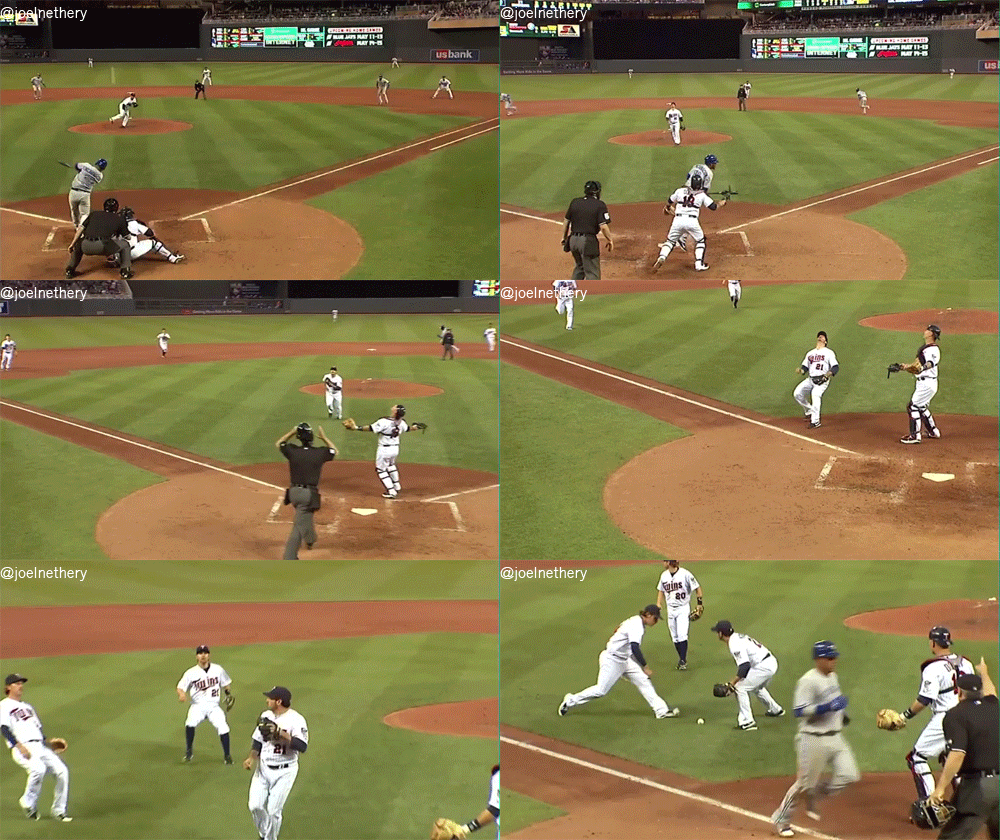
Dr M is all about the gifs lately. Lucky us!

So tip o' the hat to Dr M for sending me the vid link. What's funny is that I'd already seen it. We were at Fenway over the weekend and the jumbotron was running bloopers. That one linked above was one of the bloopers. Good times!

Monday, May 7, 2012

Slow-mo Shame

Good times and giggles here.

(hat tip: Dr M)

Sunday, May 6, 2012

Canted

This documentary is long but so worth the view. If you know me, you know that advertising will often make my blood boil. This documentary is a perfect example of why.


Originally seen here.

Thursday, May 3, 2012

Alan Rickman Reel: January Man


 My household are big fans of Alan Rickman. As such, we've decided to review his films from start to finish. Using IMDb, that puts us starting with Die Hard (DIE HARD!!!!) and continuing with January Man.

This is a step down from Die Hard.

Netflix doesn't carry this title so we had to improvise. So sgwordy read a plot summary of the film, while Dr Musacha opted to watch YouTube clips of only Rickman's scenes (courtesy of Rickmanlover) and try to guess what the movie was about.

Warning: Adult Content within clip. NOT SAFE FOR WORK


sgwordy: You know this movie was rated R. Any movie rated R in the 80s had tits whether it needed them or not. So, impressions?

Dr Musacha: About the tits or the first scene?

sgwordy: haha

Dr Musacha: I was excited after the first scene (no innuendo intended). My initial impression is that this is a movie about Kline pretending to be a hobo as part of a scam. And he's trying to recruit his painter friend as a partner. Sounds like an interesting concept for a movie.

sgwordy: Well, lucky for you you can still pitch that concept because he's actually trying to get him to help out on a murder investigation. Kline has just been asked back onto the NYPD (personal request of the mayor) and he thinks his painter friend will be really helpful as an assistant.

Dr Musacha: Hmm, that explains later scenes but not the way Kline is dressed.


Dr Musacha: Scene 2 left me with a lot of questions. Why are the least talented actors talking so much while Rickman is silent? Did this director ever work again? S/he's not getting much out of a talented group of actors. Also, what genre is this supposed to be? Feels like a comedy but I'm not laughing.

sgwordy: Turns out that is not the office the captain set aside for Kline but Painter Friend thought the light was better in this room. That would be important because his first task as assistant is, apparently, to paint birds on the wall.

Dr Musacha: Shockingly, this isn't even the stupidest turn of events in this movie.


Dr Musacha: Short and pointless, though this scene does introduce the first female character.

sgwordy: She's not the first female character.

Dr Musacha: Well, the first female character who talks. She's not just breasts on a couch.


Dr Musacha: At this point, I was convinced that instead of a hobo con, they had faked their way into jobs with the police (much like Blue Streak). Because they are bumbling fools they come up with a plan to use their new female friend as bait so they can catch the murderer.

sgwordy: Would you be surprised to learn that the woman is the daughter of the mayor?

Dr Musacha: Yes! Why would they risk the mayor's daughter in this scheme?

sgwordy: I think it's so she and Kline can spend time together so they can couple up by the end. Also, she's a friend to the most recent victim so obviously she's an expert on the situation. Do we even go into the Virgo thing or should we just leave that alone?

Dr Musacha: [speechless]

sgwordy: It is interesting that Kline has a background that makes the constellation Virgo (minus one star) immediately come to mind after a computer program inexplicably changes a bunch of squares into variously sized dots. (By interesting I mean stupid.)


Dr Musacha: Needless to say, I'm really disappointed in the outcome here. I was all jazzed up to watch a buddy comedy about two guys that pretend to be homeless to con suckers out of money.  Instead I get the dumbest plan in the history of police movies.  Did the summary you read explain why they needed to wait for the tenant of the apartment to show up before enacting their plan?

sgwordy: No, and that's a good question. Why did they wait? And why didn't I think of that before? Was it for her keys?

Dr Musacha: I guess that must be it but why didn't they use a police key or talk to the super. The whole plan is just really dumb!

sgwordy: I can't argue with that. I wouldn't even want to. Any final comments?

Dr Musacha:The world is still waiting for its buddy hobo comedy. You?

sgwordy: I'm sad. This movie makes me sad. Will there be any room for those enormous hot air balloon tits in your hobo bromance?


Summary:
Rate the movie on a scale of 1 to 10:
Dr Musacha –1, every scene in this movie feels like a practice take.
sgwordy –2

Was Rickman the best thing about this movie?
Dr Musacha –Yes, he was the only one who ignored the director and acted.
sgwordy – There was no best in this movie. It's all worst.

In the context of his body of work, on a scale of 1 to 10, how would you rate Rickman as Rickman?
Dr Musacha –3
sgwordy –3

Favorite Rickman quote from this movie?
Dr Musacha: It's irritating to me that I need money. I shouldn't need it.

sgwordy: Languish there, Darling.

Let's all just try to forget this ever happened.

Monday, April 30, 2012

Drive


Title: Drive
Studio: Bold Films (2011)


Michael and I did a little something different for our joint post series last April and we're serving up a twist again this April. (side note re April: It's also our month for meeting up in person and having awesome good times at the LA Times Festival of Books... but more on that later.) For anyone new to this series, this is where we choose a book/movie pairing and I say a few words on the book and Michael says a few words on the movie. But as you'll quickly notice, this month Michael has the book and I'm taking the movie.


I don't review films often and I had lots of jumbled/random thoughts regarding the film so I'm going to do what I do whenever I can't seem to get myself organized for a review: borrow the format of that estimable Canadian blogger, Apprentice Writer. (I shamelessly rip this format off when needs must and AW is so kind as to not mind at all... I think;)

Premise: "A mysterious Hollywood stuntman, mechanic and getaway driver lands himself in trouble when he helps out his neighbour"
(you might recognize that as more shameless stealing - this time from IMDb)

Poster: Evokes atmosphere and tone of the film to perfection. Big thumbs up.

Title: Truth in advertising

What Works:
- The chase scenes. I'm pretty partial to car chases anyway but when they are done well it's such a treat and holy damn were they done well.
- Ryan Gosling. So many jokes were made about his lack of dialogue that I was actually pretty surprised he had as many lines as he did. I was expecting a lot of Acting and Making Serious Faces, etc due to all the jokes but it wasn't like that at all. He played a quiet character and he was quiet. It's nice to see understatement allowed to work its magic.
- Bryan Cranston. I can't figure out why I heard so much about Albert Brooks after this movie released but nothing about Cranston. He blew me away! I thought he was the best part of the movie (excepting the car chases) and he nailed that part. I mean, he fucking nailed it! Try to picture other folks acting this sort of role and you'll find that they either can't be truly pathetic and submissive (there's always that angry glare directed at someone's back or a posture that says they still have some fight in them) or that they are so pathetic and submissive that you hate them or laugh at them. Cranston pulled off the nearly impossible: he played a sad, pathetic loser and instead of despising him he made the audience want to cry for him. I rarely root for criminals even when they are the protag, but I wanted his racing scheme to work out so badly that the hardest thing in the movie for me to bear was his inevitable storyline.
- The direction of the violence. This is a graphically violent movie and I've rarely seen graphic violence done so well. This was not a movie that relied on physical traits (think bad teeth) or atmospheric conditions (think ominous music and dingy neighborhoods) to help the audience know when Bad Stuff was about to happen. This was a movie where a clean-cut, handsome guy with a climber's physique could stomp someone's head to a bloody pulp on a bright, sunshiney day. My compliments of the violence aside, you have been warned, the story follows violent people and the camera is not shy.

What Doesn't:
- Ironically, and excepting what I listed above, the direction. I am a firm believer that if you are not directing a stylistic movie (think Moulin Rouge, Kill Bill, From Dusk 'Til Dawn, etc) then I shouldn't notice the directing. The only time I didn't notice the directing was in the car chases and during a violent scene. That is where the director really got it right. Otherwise, I felt like he never wanted me to forget that he was Directing.
- Irene. What a toothless role. Carey Mulligan deserves better.
- Albert Brooks. I'm listing this specifically because I want it to annoy someone so s/he will explain to me exactly what was so great about him in this role. I thought he did a fine job but I didn't think the role presented much of a challenge. I'm ready to be convinced so Brooks backers please share!
- The Driver's motivation. Was it really just that he fell in love with a pretty girl? And why? We learn almost nothing about her, so is the sum total of her appeal her looks and beautiful smile? Was it the kid? My theory on this is spoilerish so highlight if interested: The ending scene and song made me think his other part-time job is helping people out when he takes a fancy to them. During the movie I was thinking his helping of Irene was a one-shot deal and that didn't make a lot of sense to me. But then that last scene made me think that perhaps this is not his first time acting the Semi-Good Samaritan. This is another one that I hope others will share their insight on.

Overall:
Kick-ass car chases, realistic violence, and solid acting make this a film worth watching even if it's not exactly your cup of tea. A few distracting mis-steps keep me from giving it an unqualified recommendation but I still think it's a movie that will send a lot of people home happy.


Don't forget to check out the book review! And here's my favorite quote to enjoy on your way out:

I don't have wheels [slight pause] on my car.


rating: 3 of 5 stars


Click here for an index of the joint post series

Sunday, April 15, 2012

Alan Rickman Reel: Die Hard


 My household are big fans of Alan Rickman. As such, we've decided to review his films from start to finish. Using IMDb, that puts us starting with Die Hard (DIE HARD!!!!)

John McClane had other plans.


sgwordy: I’ve heard you claim that Alan Rickman plays the best action villain of all time in Die Hard. After another viewing do you still think so? Why?

Dr Musacha: Definitely. Hollywood tends to write only two types of villains right now, the crazy idiot that would get caught or killed by his own henchmen in no time, and the stone-faced underactor that never shows any emotion. Rickman’s Hans Gruber is brilliant and charismatic, he even cracks a few jokes early in the movie. But beneath the civil exterior there is a cold, calculating person that will not hesitate to use any means to get what he wants. It’s a well-rounded, terrifying package.

sgwordy: Agreed. He’s one of those villains that you know is going to actually shoot, not faff about until he loses control of the situation (exception being the end). It makes him scary and so much more enjoyable than most film baddies.

sgwordy: Would you say that’s because of Alan Rickman or how his character is written or both?

Dr Musacha: Both, the character is well written and credit should go to the writers.  But many of Rickman’s contemporaries (Nicholson, Hopper, etc.) would have resorted to chewing the scenery.

sgwordy: Interesting, would you say that has anything to do with his British accent?

Dr Musacha: [laughs] No, but I thought it was awesome when he faked an American accent.

sgwordy: Just as I thought Gruber’s stupid moment came at the end, the American accent bit was McClane’s stupid moment. His accent was disguised but not his voice.

Dr Musacha: This was Rickman’s feature film debut. Did this feel like someone making his debut?

sgwordy: Definitely not. There are so many throwaway villains whose names no one remembers but everyone knew who Alan Rickman was after this.

Dr Musacha: Do you think it’s more difficult to play a fleshed out villain or hero?

sgwordy: Hero definitely because villains almost always get more layers if they are well-written. Poorly written villains are cardboard cut-outs of stupid.

Dr Musacha: It’ll be interesting to compare his villainous turns to future heroic roles.

sgwordy: Do you sometimes wish that Gruber had lived so it could have been his series?

Dr Musacha: A well conceived villain is more important to the success of a story. You want a good hero so you [the audience] can relate but a great villain raises the stakes and gets the audience invested in the plot. Cartoonish or stupid villains undermine the tension. But no, I don’t wish he had lived because his death scene was so awesome. Plus then poor Alan Rickman might have had to be in that terrible fourth Die Hard movie, and I wouldn’t wish that on anybody.

sgwordy: I would add that a stupid villain undermines the hero because how impressed can you be with a hero who is fighting a stupid villain.

Dr Musacha: Die Hard is still considered a classic in the genre - why do you think it still resonates with people (besides Rickman and Willis)?

sgwordy: I would say because the action serves the plot, rather than vice versa. It’s not action with a plot superimposed.

Dr Musacha: I think you nailed it, and the pacing is key. The film starts with just enough background to get you interested in the characters, then meshes action with plot seamlessly the rest of the way. It’s not bunches of action interspersed with exposition of the villain detailing the plan.

sgwordy: Also, as you said above, a great villain makes a great movie. And McClane is fun, too. The script makes me cringe in parts but it’s also super awesome in parts. Additionally, I wouldn’t say it’s exactly a banner film for better opportunities for actors of color but it’s quite noticeable that being a person of color did not mean you were going to be the villain who bought it first or the good guy who gets to die serving the plot.

Dr Musacha: I’d add also that Holly is a great female character. Her part isn’t large but she’s smart, takes a leadership role, and isn’t sitting around waiting anymore than any person might have to do with a gun pointed at her head.


Summary:
Rate the movie on a scale of 1 to 10:
Dr Musacha – 9
sgwordy – 8

Was Rickman the best thing about this movie?
Dr Musacha – Tied with McClane
sgwordy – Tied with McClane

In the context of his body of work, on a scale of 1 to 10, how would you rate Rickman as Rickman?
Dr Musacha – 10
sgwordy – 8

Favorite Rickman quote from this movie?
Dr Musacha: I’m an exceptional thief, Mrs. McClane. And since I’ve moved up to kidnapping, I think you should be more polite.

sgwordy: We do it the hard way.


Die Hard, the cassette tapes, the computers, the hair!!! Good stuff, y’all!!!


Friday, March 30, 2012

The Big Sleep by Raymond Chandler

Title: The Big Sleep
Author: Raymond Chandler
Publisher: Knopf (1939)

 There are many releases/publishers for this novel. Mine was a UK version so I enjoyed a book filled with "tyres" and the like. I couldn't find a cover image so I took my own photo (featuring Hedgie and another book I read recently, and really liked) so that everyone could enjoy who I assume is supposed to be Carmen. In any case, I think Vintage's release is the easiest to get right now.


Michael and I didn't reach quite as far back as Austen's day this month but we're still kicking back with a classic. It's appropriate for us to visit one of the originals of the hard-boiled PI novels together because it was Michael who championed PI and mystery novels to me. In general, I prefer more modern authors when it comes to mysteries but it makes me feel high-brow and literary to visit those who blazed the trail. For anyone new to this series, this is where we choose a book/movie pairing and I say a few words on the book and Michael says a few words on the movie.


Philip Marlowe is hired by General Sternwood to look into a blackmail case. Sternwood has two daughters who tend to get into scrapes now and again. Sternwood is being blackmailed for the gambling debts owed by one of his daughters. The General doesn't mention anything about a missing son-in-law but, in the course of the blackmail investigation, pretty much everyone else does. Investigating both becomes a priority for Marlowe in the course of this novel.

If I sound a little sinister as a parent, Mr. Marlow, it is because my hold on life is too slight to include any Victorian hypocrisy. I need not add that a man who indulges in parenthood for the first time at the age of fifty-four deserves all he gets.

General Sternwood utters these words at the very beginning of our tale in regards to his indifference to his daughters' behavior. This is all well and good but it's a shame he's thinking of this so egocentrically. Whether he thinks he's getting what he deserves does he stop to think of whether his daughters are getting what they deserve? I was so preoccupied with my disgust with him as a parent, and the resultant contemptuous humans he financed, that I had a hard time really caring what happened to anyone. I almost got the feeling that I was supposed to have some sort of sentimental respect for the General (I'm quite sure Marlowe did) but some old guy retaining a bit of frankness is not enough to elicit my admiration. Anyway, this is all I'll say about this because it would otherwise make for a long ranty post totally focused on this guy's real stupidity in not encouraging these women into some sort of occupation. I realize it was 1939 but rich people have never been subject to the same restrictions as others. For heaven's sake, they could have taken up sailing or something. Ok, ok, shutting up now and moving on to the book.

If he ever gets wise to where you were last night in the rain, he'll wipe you off the way a cheque raiser wipes a cheque.

Yeah, it was that kind of book with that kind of language. I liked it, and it especially works in the beginning when events are crackling along at a nice pace. But it also has this sort of language:

Go ------ yourself.

Literally! Our gentle eyes cannot be abused with harsh language so it's blanked out. Extreme violence, gay and racial slurs are A-ok but (oh my!) let's be sure to keep "fuck" out of this book. How funny! It also danced around the pornography so I was never quite sure how serious an extortion ring the bad guys had going. Anyone familiar with that era's naughty pics want to enlighten me?

They put their beaks in their drinks, gurgled swiftly and went back.

Like I said the book starts off pretty action-packed but then it lulls a bit after the set-up. There is a period of time when Marlowe gets approached about the case more often then he goes out to investigate it. But, as you know, where a PI goes death was there shortly before so it doesn't lull for long. The plot, dare I say, thickens and Marlowe becomes more and more suspicious of events that appear unrelated to the blackmail.

While I enjoyed the turns of the plot and the descriptive writing style, I was never immersed in the story. Marlowe wasn't off-putting but I found no particular reason to like him all that much. He had a nice sense of justice and loyalty but that's plain good business sense for a PI. Sternwood I took in immediate dislike (the above rant probably makes that obvious) and the daughters were used as plot devices. The rest of our cast of characters were run of the mill baddies or too briefly seen to be interesting. I find it very difficult to really enjoy a story if I don't have a character with whom I can empathize. It doesn't matter if it's a hero or a baddie, I just need someone who I can connect with emotionally or via a clear motive.

It's nice to explore the root of a genre by taking these historical reads but for my avid reading I know I'm more likely to seek out modern mystery writers. Where do you stand on the classics?

Don't forget to check out the film review! And here's my favorite quote to enjoy on your way out:

"Tsk, tsk," I said, not moving at all. "Such a lot of guns around town and so few brains."


rating: 2 of 5 stars


Click here for an index of the joint post series

Saturday, March 10, 2012

*erm*

Back when I used to watch every movie that came out rather than just every movie trailer, back when I worked in a video store (pre-DVDs and everything!), back when I lived at the beach... oh wait, that's not right... anyway.... Back then, I took a fairly large amount of pride in giving good movie recommendations. If you would kindly share a few titles you liked and why, I was pretty sure I could get you out the door with something you'd like. My feedback was universally positive which either speaks to my success rate or the kindness of movie store patrons in not blaming me if it didn't work out.

My pride in recommendations has retired from the movie realm and moved into the book realm. I've always been a bookworm but I now have so many more people around me that read for pleasure. I guess in high school and college folks were just trying to get through the required reading. Or just weren't interested or who knows, but the point is, yay, more people I know are reading these days. So now I get a little information about the books a person likes and proceed to make recommendations. I have learned that this is not what everyone does. I have learned this the hard way.

What do you do when a friend recommends something and it's crap? I don't mean that you simply don't like it but that it's crap. Crap = poorly written, uses offensive stereotypes, relies on cliches rather than character development, etc. What do you say? I'm still searching for the appropriate way to discuss material that actually offends me but here's what I want to say:

You and I just discussed various titles and talked about why we liked them and you still thought this title would be acceptable to me? Why? WHY? And while we're at it, why doesn't the sucky writing bother you? Do you not care about character development? And, ok, maybe this is a "just for fun" title so then I have to ask: why aren't you offended at the egregious homophobia/sexism/racism? What is wrong with you????

Do you see why I am still formulating a better response?

Wednesday, February 29, 2012

Persuasion by Jane Austen

Title: Persuasion
Author: Jane Austen
Publisher: Penguin Classics (2003)
Originally published in 1817

My love of Austen is no big secret and Persuasion is even the one I thought of first when I made a short Keeper List (though I have them all obviously and in multiple formats, too:). However, I've never read this title with quite so critical an eye or with a mental comparison to the movie running through my mind. For this new experience I can thank Michael for agreeing to queue up what will be the third romance in our joint post series. For anyone new to the series, this is where we choose a book/movie pairing and I say a few words on the book and Michael says a few words on the movie.


Anne Elliot is the middle daughter of a spendthrift and self-important English baron. Eight years before the events of the novel she gave in to family pressure (including pressure from family friend and surrogate mother Lady Russell) and broke her engagement to Captain Wentworth. At the time of the engagement, Wentworth was a mere Mr and not in possession of any significant assets. All this made him far below what the Elliots considered eligible for a daughter of the family.

Sir Walter Elliot's poor budgetary skills have forced the family to remove from their ancestral seat and take a home in Bath. Their new tenants are none other than Wentworth's sister and husband (the world of Austen is always a small one). Anne remains in the neighborhood with her younger sister's family or Lady Russell for several months. When Wentworth comes to visit his sister they are often in company together. It's awkward and, for Anne, often painful because she still loves him. When he begins to court one of the neighbors' daughters, Anne tries to resign herself to fully letting him go.

What first drew me to Austen back in my high school days was her biting wit. I read very, very few romances back then (in fact, Austen is the only romance writer I can remember reading) and it wasn't for the romance that I kept going back to Austen: it was the zingers. Austen's books are like onions (or parfaits, everybody likes parfaits): you can read them for the romance, you can read them for the accurate portrayal of life in Regency England, or you can read them for the awesome satire. She must have been wonderfully observant because you just couldn't make up the ridiculous things some of the characters do or say. And the little asides that make, with very English restraint, an observation perfectly clear are just delightful.

Lady Elliot had been an excellent woman, sensible and amiable; whose judgement and conduct, if they might be pardoned the youthful infatuation which made her Lady Elliot, had never required indulgence afterwards.

If it wasn't already obvious, how gently Austen tips the reader to Sir Walter's uselessness as a person. Austen also had such an eye for the realities of a genteel life. She was the daughter of a Reverend so not rich but still amongst a set of people who often had no occupation whatsoever. Doubly so since a woman's sphere was quite small and completely in the hands of a guardian or husband. She teases out how an idle life can lead to a ridiculous nature. Anne's younger sister is married with children but not at all comfortable with a life with too little to do which manifests in pettish illnesses and obnoxious behavior.

She could soon sit upright on the sofa, and began to hope she might be able to leave it by dinner-time. Then, forgetting to think of it, she was at the other end of the room, beautifying a nosegay; then, she ate her cold meat and then...

Austen must certainly have had a healthy appreciation for the ridiculous and Austen readers often do as well.

Anne always contemplated them as some of the happiest creatures of her acquaintance; but still, saved as we all are, by some comfortable feeling of superiority from wishing for the possibility of exchange, she would not have given up her own more elegant and cultivated mind for all their enjoyments...

The real circumstances of this pathetic piece of family history were, that the Musgroves had had the ill fortune of a very troublesome, hopeless son; and the good fortune to lose him before he reached his twentieth year...

But in the midst of these little asides, petty family dramas, and painfully close views of the limited options available to women at the time, there is always a very satisfying romance to thread it all together.

Alas! with all her reasoning, she found, that to retentive feelings eight years may be little more than nothing.

The perspective is a little scatter shot but always more from Anne's perspective than from Wentworth's. It's clear early on that Anne has never lost her love for Wentworth and, as the story progresses, it's also obvious that Wentworth still cares for Anne. But, in case you're curious, ditching your fiance because your family tells you to is not exactly received well by the ditchee. Wentworth is hurt and looking for excuses to keep distant from Anne. The Musgrove daughters offer plenty of opportunity for distraction.

What I admire in Anne is that she regrets the loss of a companion she held (and holds) so dear but she never regrets her decision. For all the ridiculousness of her family (and, truly, she's the only sane one of the bunch) her loyalty to her family is quite high. In light of this, she is convinced that a happy marriage would not have been hers were she to have married against her family's wishes at such a young age. Whether you agree or not with her sentiments, it's easy to understand why she made her decision. It's also easy to understand how, at the ripe old age of 28, she's gained some independence from the over-bearing influences of her youth. Her decisions now will be much more guided by her own desires (Wentworth having made his fortune doesn't hurt when it comes to family acceptance either).

The novel is rather somber in tone, both in the dispositions of the heroine and hero but also in their courtship. Fairly or unfairly, second chances rarely appear as romantic as first love and they both have legitimate challenges in living down what happened 8 years ago. Still, Austen won't leave you long without a laugh.

By this time the report of the accident had spread among the workmen and boatmen about the Cobb, and many were collected near them, to be useful if wanted, at any rate, to enjoy the sight of a dead young lady, nay, two dead young ladies, for it proved twice as fine as the first report.
(no one actually dies in the book:)

Obviously, I loves me some Austen! This is getting crazy long and I still have so many notes in the ol' Kindle. How about I leave with one last thing. Even in this, Austen's last novel, her style retains some of the hallmarks of stories read aloud for the family. She doesn't stealthily weave in back story or current events: she simply spells them out - as is expedient - at the beginning of the story when setting a scene.

Yet so miserably had he [Elliot heir] conducted himself, that though she was at this present time (summer of 1814) wearing black ribbons for his wife, she could not admit him to be worth thinking of again.

And that's a little bit how you feel during the story. You get a close view of someone's home life. You see the small disappointments and revel in the triumphs... You wonder how you can read one more paragraph about the stupid father or the tedious sister... But, then, you can't choose your relatives and when the sphere of your existence is limited the only stage you have is the one you were born into.


rating: 5 of 5 stars


Click here for an index of the joint post series

Tuesday, February 7, 2012

What the f$#k, People?

Teleflora* makes a commercial equating women to prostitutes** (and NBC willingly broadcasts it) but it's M.I.A. making an immature and crude gesture (which a lot of people probably missed) during the Super Bowl halftime show that gets all the news?

What the fuck, People?

* I refuse to link to their site or the offending commercial. I don't want the interbots to give them any positive feedback.

** Come to think of it, using the word prostitute here is probably an insult to prostitutes. At least they are self-employed.


Wednesday, February 1, 2012

Linky Love

Need a laugh? Click here.

(hat tip: Sum of Me)


Monday, January 30, 2012

The Maltese Falcon by Dashiell Hammett

Title: The Maltese Falcon
Author: Dashiell Hammett
Publisher: Various, originally serialized in the magazine Black Mask (1930)


Michael and I have emerged from The Slide and, with 2012 well under way, it's time to kick-start the joint post series wherein I review a novel and Michael reviews its movie adaptation. Our little project began way back (*grin*) in May of 2010 and has been one of the unexpected joys of my blogging habit. My reading life has been enriched by our exchanges, which is something every avid reader appreciates. Plus, I can now boast of having acquired the skills needed for audiobooks. I remain a neophyte but my training moves along nicely.

The year did not begin with rainbows and kittens and confetti in sgwordy's circle of existence so it was a relief that we went with a title I had already read and seen (great suggestion, Michael!). And, as luck would have it, I'd already posted about this book. Since I'm going to do the copy/paste deal (with minor editing for clarity's sake) I thought I would at least spice things up by including some informative links for anyone not familiar with Dashiell Hammett or this classic private eye novel.  The first and most important link, though, is:


I found this bio to be thorough and interesting. From the same website, some info on the book. This bio [ETA: no longer exists] is a little shorter if you're in a hurry. This link has a list of, I think, Hammett's short stories and then various analyses/comments on his plots and novels. And now, for my two cents.


It very well could be that I had a This Is Spinal Tap experience with Hammett's The Maltese Falcon. After a couple Behind the Music marathons the brilliance of This is Spinal Tap is slightly overshadowed by the real thing. Of course I laughed and enjoyed it (seriously, how can you not laugh at the tiny bread? don't remember the tiny bread? click here) but I obviously didn't see it at the right time. We've all experienced this, right? You were so excited but then it turns out you saw/read something after the hype or after the right age has completely passed you by? Well, anyway, this might be the case with me and this book. But how about a synopsis first...

San Francisco PI, Sam Spade, is hired by Brigid O'Shaughnessy to help reunite her with her sister. Brigid is pretty sure her sister is kickin' it with a bad man and she'd like help getting her sister away from him. This is all lies, of course, and after the death of his partner Spade becomes embroiled in recovering a stolen statue (see title). Just who stole the statue and who is its rightful owner depends entirely on who is telling the story.

I have to say right up front that my favorite thing about this book was that it was in the 3rd person. My little heart just pitter pattered with love and appreciation when I saw that. It's not that I mind 1st person that much but that my recent mystery/crime/thrillers had mostly been 1st person and I was getting sick of that perspective. So huzzah and hooray for a different perspective whilst solving a mystery. Irrelevant side note: I felt the book had no rhythm. This might seem an odd statement but as a speed reader I'm extremely sensitive to rhythm in books. No rhythm = very difficult to speed read. What I can't say for sure is whether I need the rhythm to fit my brain or if books simply have natural rhythms that I pick up on. It may be a little of both, though, because often enough I come by books (most recently Mrs. Dalloway [Woolf]) and The Mystic Arts of Erasing All Signs of Death [Huston]) that take me 3-4 chapters to find their rhythm. Only after I've found it, am I able to speed read (note: I don't always speed read but I'm irrationally put out if the option is taken away:). Anyway, noticing this rhythm thing got me to thinking about what exactly might remove rhythm from a book and my best guess for this book is that it was due to the odd way in which Hammett described action.

Hammett doesn't exactly take short cuts when describing action. In fact, I'm hard pressed to recall if the word "punch" was ever used, though certainly several punches were thrown. He has a very distinct style in that he takes you practically step-by-step through the action. A condensed example:
Spade pushed Cairo gently aside and drove his left fist against the boy's chin. The boy's head snapped back as far as it could while his arms were held, and then came forward...Spade drove his right fist against the boy's chin. Cairo dropped the boy's arm, letting him collapse against Gutman's great round belly. Cairo sprang at Spade, clawing at his face with the curved stiff fingers of both hands. Spade blew his breath out and pushed the Levantine away...Spade stopped him with both palms held out on long rigid arms against his face.

There's nothing at all wrong with the style but much of the info listed I can perfectly imagine on my own and, frankly, would assume: heads snapping when punched, stiff fingers when scratching, it would obviously take rigid arms to stop someone in that way, etc. Again, nothing wrong with it, it's just that, for me, it resulted in a lack of rhythm. And also, it gave the action a stop-motion quality. Since each step was detailed my brain imagined everything happening much slower than it would in reality.

I liked the twists and turns of the plot but felt it was a tad bogged down in the info-dumping dialogue used to explain it. Also [spoilerish: highlight if interested], why the fuck did Effie and Sam trust Brigid even a little bit. I spent the whole book just waiting for her crumbumness to become known. My favorite character was probably Gutman because he made me laugh and was surprisingly pragmatic. Speaking of characters/characterization I especially liked how it was established that Spade has no idea how to relate to women in a non-sexual manner. I preferred that to many of my experiences with leading men who inevitably end up in the sack with the leading lady because it was more to do with Spade's social adjustment (or lack thereof depending on perspective) than Leading Man Sees Leading Lady, Must Humpty Hump Right Damn Now. I will refrain from any other gender relation explorations as possibly is unfair to judge a book that is ~80 years old in this manner.

From these comments are you getting my whole This Is Spinal Tap experience thing?

I liked the book well enough though not so much that I will run right out and get more Hammett or even recommend him to anyone. I am interested in The Thin Man though so will probably look out for it sometime in the future. But again, no rushing from me. [editor's note: how true, over a year later and i still haven't read this]

There are a lot of great lines in the book and I'm going to leave you with my two faves:
Gutman: "...but we were talking then. This is actual money, genuine coin of the realm, sir. With a dollar of this you can buy more than with ten dollars of talk."

Spade: "That's the trick, from my side," he said, "to make my play strong enough that it ties you up, but yet not make you mad enough to bump me off against your better judgment."

rating: 3 of 5 stars


Click here for an index of the joint post series

Tuesday, January 24, 2012

Powder of Love by Summer Devon

(review format shamelessly ripped off from Apprentice Writer)

Author: Summer Devon
Publisher: Loose Id (2011)

Premise: An unexpected and exotic inheritance creates an unlikely partnership, and the sparks fly almost immediately.

Cover: Title - Oh my gosh! I love it! I am such a sucker for puns and I should be above being so tickled by this small bit of word play but I am not. Art - I prefer illustration to live models but the bonus here is that the cover didn't bother me and the models so often do. I like the period buildings in the back and the artfully arranged desktop. In any case, it's a tasteful cover and clearly a romance. Truth in advertising is always nice.

What works:
Rosalie and Gideon are extremely likable. I rooted for them both right away and their immediate attraction was something I believed. Walter cracked me up and, no matter how perverse his interests, I never really had it in me to dislike him. Plus, I enjoyed his teasing manner with Gideon, and because I didn't have Gideon's job I never had to be overly annoyed with him. Rosalie has a companion and she gets a romance story, too, which I loved because the whole scenario was as adorable as a basket of kittens.

It's funny. There were some moments when I was definitely giggling along with Rosalie:

...but then she recalled Mr. Dorsey, who'd obviously opened the box and overcome its influence. For a horrifying moment, she imagined him in an aroused state similar to this, but pushed the image out of her mind.

Trust me, after a scene with Mr. Dorsey you're going to be horrified, too, and laughing at Rosalie having to deal with this mental image.

Then there are the perceptive things that Rosalie will say:

"I am not prone to caring for the good opinions of others. It's such a restful thing to go along with one's own judgment and not seek the approval of others."


What doesn't:
The action/dialogue did not always feel as if it served the plot but that it served to get some more hanky panky going on. Now, I believe that is the point of books under this publisher but I would have liked it a bit more had the sequences been more of a result of actions of the characters rather than it feeling like the characters simply needed to move on to reach the next hanky panky.

I never once had any doubt that Rosalie and Gideon would get together. This might seem like a stupid comment because that is always the guarantee in a romance but, for me, the best stories have that moment of doubt. I don't mean That Thing that happens Just Before the End to keep our lovers apart right after it seems their HEA is on the horizon but a true moment where I think, "Oh shit! Is this not going to work out?"

Lastly, and this is nitpicky, there were a couple things that made the scientist in me go, "Wait a minute!" When Rosalie takes the powder to a researcher she wants to see his lab to ensure that he's well-equipped to work with it. She knows that simple inhalation is all that is needed for a reaction to occur (and this powder has quite the range and is speedy, too, in the air) but doesn't insist that he wear some kind of mask and is actually pretty close to it herself. Woops! The density of the powder also made me go, "Eh?" There's a point when 10 grams of powder is missing. My mind immediately imagines 10 grams of a powdery substance that is light enough that it will immediately go airborne thus becoming an inhalation risk. My mind chose Agarose and 10 grams of that would probably cover a playing card and be about at least quarter of an inch high. but then, whoops, "the powder is dense, heavy. So that's probably about the size of, say, half a pea." Then my mind got to wondering if the doctor would have even used grams during this time period, New York 1880 (I know, picking nits... what can I say? When I start down a science path my mind gets going). A quick search tells me that the Metric Act of 1866 made it legal to use the metric system in the US but that the US didn't receive measurement standards until 1889. I can't really say for sure, though I'd really like to know as the history of scientific research is really interesting to me, but I'm inclined to think he wouldn't have used metric. Can anyone settle this for me?

Overall:
Easy to like characters and a story that fulfills the needs of a publisher leaning towards the erotic make this a very palatable read for anyone looking out for this type of romance. Bonus: it might be termed erotic light so it could be a "gateway" for anyone looking to explore erotic romances. Don't be intimidated by Loose Id's disclaimer... I can't find a link straight to it and I don't want to copy it out but this freaking awesome disclaimer includes "do not try any new sexual practice... without the guidance of an experienced practitioner." I wonder if they have any "experienced practitioners" to recommend to me. ;-)


This book kindly provided by the author
This blogger kindly asks the author to forgive her for taking a geologic age to post a review


Monday, January 16, 2012

More Linky Love

ETA: More on this topic.

Shannon Hale makes a very good point in this post.

To it, I would add that another limitation of only teaching classics is that the classics mentioned in the article (and almost all of the classics I was ever assigned to read) are entirely of Greek/Latin and European origin. It's a wide, wide world and more people might be interested in classics if the accepted list was more reflective of that wide world.

Also, could that guy be more snobbish? Jeez!

Tuesday, January 10, 2012

2011 Favorites

Favorite fiction: Three-way tie!
The Brief Wondrous Life of Oscar Wao by Junot Diaz
The Known World by Edward P. Jones
Shibumi by Trevanian

Favorite non-fiction: Three-way tie!
Dark Alliance by Gary Webb
The Immortal Life of Henrietta Lacks by Rebecca Skloot
Moneyball by Michael Lewis

Favorite mystery/thriller: Bury Me Deep by Megan Abbot
This literally came down to about five books because I practically stopped reading mystery/thrillers in Feb. This cannot be explained after a mys/thriller glom in 2010. I even meant to participate in a mystery reading challenge and, well, that didn't actually happen...

Favorite historical fiction: Roots by Alex Haley

Favorite fantasy: Assassin's Apprentice by Robin Hobb
This was also a sparse fantasy year.

Favorite Sci-fi: Dawn by Octavia E. Butler

Favorite Romance: Civil Contract by Georgette Heyer

Surprise hit: Reality is Broken by Jane McGonagel

Surprise blunder: Tie!
The Calculus Diaries by Jennifer Ouellete
Robopocalypse by Daniel H. Wilson

Favorite author discovered in 2011: Trevanian

Most re-read book first read in 2011: A couple Georgette Heyer books go here. They're short, cute, and comforting when I read a couple duds in a row or a book that leaves me emotionally wrung out.

Most recommended and recommendation actually taken: The Immortal Life of Henrietta Lacks

Most recommended books I wish people would have read but usually didn't:
The Brief Wondrous Life of Oscar Wao by Junot Diaz
Dark Alliance by Gary Webb
Reality is Broken by Jane McGonagel

And since I do occasionally do something other than read...

Movies:
Favorite - Brokeback Mountain*
Surprise hit - Love and Other Drugs
Surprise blunder - 30 Minutes or Less and Source Code
*I know this is sort of cheating but I didn't watch it until 2011 so it was new to me. Also, I don't think I saw anything in 2011 that I was truly excited about
(I do actually watch films that do not star Jake Gyllenhaal)

Video games:
Favorite - Resident Evil: 4 (Leon is back!)
Surprise hit - Brickbreaker (which made getting rid of my Blackberry so very sad)
Surprise blunder - Assassin's Creed: Brotherhood (but, of course, I still loved it even if I didn't love it - yeah, I can't explain it either)

Past Editions: 
2010 Favorites

Saturday, January 7, 2012

Technical Topic - Narrative Non-fiction

This is a great interview of Rebecca Skloot with its main topic being structure. Very interesting stuff.

Tuesday, January 3, 2012

Things Fall Apart

IF by Rudyard Kipling

IF you can keep your head when all about you
Are losing theirs and blaming it on you,
If you can trust yourself when all men doubt you,
But make allowance for their doubting too;
If you can wait and not be tired by waiting,
Or being lied about, don't deal in lies,
Or being hated, don't give way to hating,
And yet don't look too good, nor talk too wise:

If you can dream - and not make dreams your master;
If you can think - and not make thoughts your aim;
If you can meet with Triumph and Disaster
And treat those two impostors just the same;
If you can bear to hear the truth you've spoken
Twisted by knaves to make a trap for fools,
Or watch the things you gave your life to, broken,
And stoop and build 'em up with worn-out tools:

If you can make one heap of all your winnings
And risk it on one turn of pitch-and-toss,
And lose, and start again at your beginnings
And never breathe a word about your loss;
If you can force your heart and nerve and sinew
To serve your turn long after they are gone,
And so hold on when there is nothing in you
Except the Will which says to them: 'Hold on!'

If you can talk with crowds and keep your virtue,
' Or walk with Kings - nor lose the common touch,
if neither foes nor loving friends can hurt you,
If all men count with you, but none too much;
If you can fill the unforgiving minute
With sixty seconds' worth of distance run,
Yours is the Earth and everything that's in it,
And - which is more - you'll be a Man, my son!


Of course I am a woman and a daughter but the sentiment remains. Whenever I don't feel grown up enough for life, this poem makes me feel better.

This New Year I have had reason to give thanks for my many blessings. Well, I have reason every year and every day but every once in a while something happens to bring home to me how lucky I am. It just happened to be around the holidays this year. I wish peace and happiness were as easy to dole out as words and blog posts.

I hope you, too, can give thanks for your blessings. And if, perhaps, you or someone you know is going through a hard time please accept the peace and happiness I am so desperately wanting to share with those that need it. Things can fall apart so quickly.