If you thought you knew all the depressing little perfidies that led the US into Iraq you, like me, might be surprised to learn that the truth of their creation is beyond belief. Except, it's not. I mean, it is, but since it happened there is no choice but to believe it. How awful! How very awful!
Anyway, if interested, check out The Way of the World. And keep in mind that the message is ultimately hopeful, but the history is pretty damn depressing.
Item of note: I detest the title. It's a bit over-stated as compared to the book's actual content.
And, finally, I don't think I've ever used a word more precisely than the use of 'perfidy' up there. I'm not going to claim to have just used it more precisely than anyone ever before but I think I at least made the top 5.
perfidy - deliberate breach of faith; calculated violation of trust; treachery
Thursday, October 21, 2010

Friday, October 15, 2010
Time to give Moo another try?
I tried to read Moo by Jane Smiley years ago but I wasn't able to get into it (though Horse Heaven is one of my favorite reads). But I'm thinking it's time to give it another try. The reason? My view from the bike path as I head to my building:


Thursday, October 14, 2010
Storybook Love, or The Princess Bride cont.
Tuesday, October 12, 2010
The Princess Bride by William Goldman
Title: The Princess Bride: S. Morgenstern's classic tale of true love and high adventure: the "good parts" version
Author: William Goldman
Publisher: Ballantine Publishing Group (1998); originally published 1973
Michael (of Lazy Thoughts From a Boomer fame) and I are back with another set of reviews for a book that has been adapted for the screen.
Click here for Michael's review of one of the awesomest movies ever made!
Continue reading below for my review of a book that was published some years back. (Oops! Have I already given away my tepid-at-best feelings toward this book?)
Review: the "good parts" version - The Princess Bride is, basically, a big spoof that works much better as a movie than as a book.
Review: unabridged version - Buttercup has grown up on her parents' farm and has been happily mistreating Farm Boy for many years. (During this time she is also becoming one of the most beautiful women in the world, this is outlined by the narrator as she moves up in the top twenty.) One day she realizes she is in love with Farm Boy. He has loved her for years (no idea why) and wants to provide a nice farm for her so he sets off to "seek his fortune" but he is captured and killed by the Dread Pirate Roberts on his way to America. Devastated, Buttercup swears to never love again. Some time and events pass and Prince Humperdinck decides that Buttercup will be his wife. (Don't worry, she doesn't love him.) In the weeks leading up to the marriage, she is kidnapped by a trio of mercenaries but then re(?)kidnapped by the Dread Pirate Roberts.
A note on the narrator: I've read this book 2 times now and still can't figure what the shit Goldman was thinking with this narrator. The idea is awesome but in reality, well... In brief, Narrator's dad used to read him the awesome Princess Bride story by S. Morgenstern. Narrator wants his son to experience it as well but when they start to read the book on their own it turns out Narrator's dad had edited out all the long/boring stuff (thus, the "good parts" version). So as you read along in The Princess Bride the Narrator often cuts in to explain what he edited out. It's a fun idea, and certainly amusing at times, but the Narrator is such a right, royal jizzwad that he completely ruins the story. Seriously! I'm sitting there trying to enjoy The Princess Bride but all I can think is how I want to poke ice picks into Narrator's eyes. I skipped most of his parts this time around and I suggest that if you are the type of person who can have a story ruined by the proximity of dickish behavior that you skip his parts, too. At the very least, pass up on the introduction.
Ok, on to the book...
I go back and forth between thinking Goldman made a truly fantastic spoof or just a total crap book. "Let me explain. No, it would take too long." (hahahahaha) I'll list a few things I liked and then get on to what it is about the book that grates on my last nerve.
Good stuff -
Inigo and Fezzik
Prince Humperdinck
The word "humperdinck"
The Fire Swamp
The presence of the mysterious "holocaust cloak" is explained and it's something I'd always wondered about in the movie.
Other Stuff -
The writing/plot/characterization are completely wooden if you don't understand fantasy/adventure stories (and a little bit even if you do). I want to think this is part of the spoof. The idea here being that you accept all these ridiculous things because you do understand fantasy/adventure stories and it's part of the spoof. The thing is, I love spoofs but something about this one falls hella flat. I spent most of my time being annoyed rather than amused.
Buttercup is the most useless individual alive in the story's two fictional countries - and possibly the world. She may as well have been a mussel for all she brought to the book. Seriously! Why did Westley (our erstwhile Farm Boy) ever fall in love with her? I mean, yeah, the depth of his character was illustrated by the fact that he reads Books* so there's not much to him either but throughout the story we see that he Reads,* has ambition, is a great swordsman, is very strong, is an excellent strategist, is loyal, is funny and Buttercup is... holy hell she's too boring to even come up with a derogatory term. I'd say she's stupid (this is the girl who spent 6 months in "princess classes" and can't even fracking spell divine) but that seems to be attributing more to her character than was intended. Gah! But again, I'm hoping this is the spoof. You have your typical More Awesome Than Awesome hero and your Too Useless to Live heroine. But again again, it's more annoying than anything else.
Inigo and Fezzik are pulled straight from the canon. They are not unique or developed. They both play into caricature types that are meant to appeal to readers on an immediate emotional level. These two and Prince Humperdinck are what work well within the spoof framework. They embody archetypes we've seen done well and done poorly and done ad naseum but they are still likable in their own right and bring much to the story. That's good spoofing.
I made a few notes on this read through with the intention of being a bit more in depth and including examples of why the book didn't work for me but the idea of flipping through to the relevant sections simply bores me (a bit like the book). For whatever reason this spoof/story just does not work for me in book form. Maybe if I didn't love^ the movie so much the book would have worked better but, alas, it's not to be. I will once again leave my movie thoughts for over at the movie review but trust me when I say that the true genius here was Goldman turning this into a screenplay. I wonder if he, too, realized this story wasn't made for a book and a movie was the way to go.
So be sure to skip this book and go straight to the movie, and the movie review by clicking here!
*Books being a generic description of never-actually-named books that characters read when authors are not interested in properly developing characters (these characters are closely related to those who Quote (hat tip: Jed))
^love as in luuuuuuuuuurrrrrrrrrrrve with big smoochie xxx's and a giant throbbing heart
rating: 2 of 5 stars
Click here for an index of the joint post series
Author: William Goldman
Publisher: Ballantine Publishing Group (1998); originally published 1973
Michael (of Lazy Thoughts From a Boomer fame) and I are back with another set of reviews for a book that has been adapted for the screen.
Click here for Michael's review of one of the awesomest movies ever made!
Continue reading below for my review of a book that was published some years back. (Oops! Have I already given away my tepid-at-best feelings toward this book?)
Review: the "good parts" version - The Princess Bride is, basically, a big spoof that works much better as a movie than as a book.
Review: unabridged version - Buttercup has grown up on her parents' farm and has been happily mistreating Farm Boy for many years. (During this time she is also becoming one of the most beautiful women in the world, this is outlined by the narrator as she moves up in the top twenty.) One day she realizes she is in love with Farm Boy. He has loved her for years (no idea why) and wants to provide a nice farm for her so he sets off to "seek his fortune" but he is captured and killed by the Dread Pirate Roberts on his way to America. Devastated, Buttercup swears to never love again. Some time and events pass and Prince Humperdinck decides that Buttercup will be his wife. (Don't worry, she doesn't love him.) In the weeks leading up to the marriage, she is kidnapped by a trio of mercenaries but then re(?)kidnapped by the Dread Pirate Roberts.
A note on the narrator: I've read this book 2 times now and still can't figure what the shit Goldman was thinking with this narrator. The idea is awesome but in reality, well... In brief, Narrator's dad used to read him the awesome Princess Bride story by S. Morgenstern. Narrator wants his son to experience it as well but when they start to read the book on their own it turns out Narrator's dad had edited out all the long/boring stuff (thus, the "good parts" version). So as you read along in The Princess Bride the Narrator often cuts in to explain what he edited out. It's a fun idea, and certainly amusing at times, but the Narrator is such a right, royal jizzwad that he completely ruins the story. Seriously! I'm sitting there trying to enjoy The Princess Bride but all I can think is how I want to poke ice picks into Narrator's eyes. I skipped most of his parts this time around and I suggest that if you are the type of person who can have a story ruined by the proximity of dickish behavior that you skip his parts, too. At the very least, pass up on the introduction.
Ok, on to the book...
I go back and forth between thinking Goldman made a truly fantastic spoof or just a total crap book. "Let me explain. No, it would take too long." (hahahahaha) I'll list a few things I liked and then get on to what it is about the book that grates on my last nerve.
Good stuff -
Inigo and Fezzik
Prince Humperdinck
The word "humperdinck"
The Fire Swamp
The presence of the mysterious "holocaust cloak" is explained and it's something I'd always wondered about in the movie.
Other Stuff -
The writing/plot/characterization are completely wooden if you don't understand fantasy/adventure stories (and a little bit even if you do). I want to think this is part of the spoof. The idea here being that you accept all these ridiculous things because you do understand fantasy/adventure stories and it's part of the spoof. The thing is, I love spoofs but something about this one falls hella flat. I spent most of my time being annoyed rather than amused.
Buttercup is the most useless individual alive in the story's two fictional countries - and possibly the world. She may as well have been a mussel for all she brought to the book. Seriously! Why did Westley (our erstwhile Farm Boy) ever fall in love with her? I mean, yeah, the depth of his character was illustrated by the fact that he reads Books* so there's not much to him either but throughout the story we see that he Reads,* has ambition, is a great swordsman, is very strong, is an excellent strategist, is loyal, is funny and Buttercup is... holy hell she's too boring to even come up with a derogatory term. I'd say she's stupid (this is the girl who spent 6 months in "princess classes" and can't even fracking spell divine) but that seems to be attributing more to her character than was intended. Gah! But again, I'm hoping this is the spoof. You have your typical More Awesome Than Awesome hero and your Too Useless to Live heroine. But again again, it's more annoying than anything else.
Inigo and Fezzik are pulled straight from the canon. They are not unique or developed. They both play into caricature types that are meant to appeal to readers on an immediate emotional level. These two and Prince Humperdinck are what work well within the spoof framework. They embody archetypes we've seen done well and done poorly and done ad naseum but they are still likable in their own right and bring much to the story. That's good spoofing.
I made a few notes on this read through with the intention of being a bit more in depth and including examples of why the book didn't work for me but the idea of flipping through to the relevant sections simply bores me (a bit like the book). For whatever reason this spoof/story just does not work for me in book form. Maybe if I didn't love^ the movie so much the book would have worked better but, alas, it's not to be. I will once again leave my movie thoughts for over at the movie review but trust me when I say that the true genius here was Goldman turning this into a screenplay. I wonder if he, too, realized this story wasn't made for a book and a movie was the way to go.
So be sure to skip this book and go straight to the movie, and the movie review by clicking here!
*Books being a generic description of never-actually-named books that characters read when authors are not interested in properly developing characters (these characters are closely related to those who Quote (hat tip: Jed))
^love as in luuuuuuuuuurrrrrrrrrrrve with big smoochie xxx's and a giant throbbing heart
rating: 2 of 5 stars
Click here for an index of the joint post series
Thursday, September 23, 2010
Seen On a LiveJournal Icon
English: a language that lurks in dark alleys, beats up other languages and rifles through their pockets for spare vocabulary.
Monday, September 20, 2010
Eating the Dinosaur by Chuck Klosterman
Title: Eating the Dinosaur
Author: Chuck Klosterman
Publisher: Simon & Schuster (2009)
I truly have no idea how to summarize Eating the Dinosaur so I'm going to borrow a line from the jacket copy - "It's amateur anthropology for the present tense, and sometimes it's incredibly funny." I think this does a pretty good job. I'd add that between the laughs you might find yourself saying, "That is so true" or "That's how I feel" or "What is he talking about?" All of which ends up making for a fun little read.
Topics addressed in this "anthropology for the present tense" book include Nirvana, football, ABBA, voyeurism, laugh tracks, Ted Kaczynsky, and a host of other random bits of pop culture and current events. One of my favorite things about the book is the Q&As between each chapter. I guess these are actual Q&As from his journalism career but it's not really explained. Either way, they are hilarious.
The book is well-written and, though tending toward over-statement, Klosterman fills it with very nice turns of phrase. For instance:
Take the wolf, for example: I suspect it's unbelievably stressful to be a wold. The world would bean endlessly confusing place, because a wolf has limited cognitive potential and understands nothing beyond its instinct and is own experience. Yet the world is more engaged with the experience of being alive.
Music that skews inauthentic is almost always more popular in the present tense. Music that skews toward authenticity has more potential to be popular over time, but also has a greater likelihood of being unheard completely.
And this is football's interesting contradiction: It feels like a conservative game. It appeal to a conservative mind-set and a reactionary media and it promotes conservative values. But in tangible practicality, football is the most progressive game we have - it constantly innovates, it immediately embraces every new technology, and almost all the important thinking about the game is liberal.
He also has a healthy sense of the fact that not every topic will appeal to every reader. (Evidenced by a footnote that includes "And if you didn't already know that, I am pretty fucking impressed you're still hanging with this [topic].") And it's true, not every topic kept my interest. That was fine with me as there's no reason why you can't skip to the next chapter. Each is self-contained so if your interest is waning a couple pages into a chapter then flip to the next one, no problem.
I do have a couple nits to pick. First, there was this odd tone of sexism that would crop up from time to time. Examples: he's describing a media/star relationship with what I interpreted as a derogatory tone for the announcers because of their "girlish worship." Why is "girlish" worship bad? Is it different from "boyish" worship? Is worship gender dependent? Would it have been better to say "adolescent?" For me, the answer is yes as it would have conveyed more meaning. "Girlish" has little meaning for me in this context because I don't personally find it to be a derisive term (no matter how many times I see people trying to use it that way). I get that it's supposed to be derisive from his tone but that's bad form in my opinion and, again, bad word choice. In another instance, he's talking about his wife hating football and adds "as wives are wont to do." Hunh? Again, what is the information that you're trying to convey? Wives are such a drag due to their apparently universal football hating ways? I'm a wife and I love football. I know a lot of wives that love football. And, anyway, even if I didn't love football how is that relevant to my husband (as the context of this paragraph is making clear that it is)? If his hobby was football and I didn't share it, what is the big fucking deal? So he watches football and I do something else. Is it such a big deal to pursue separate hobbies?
The second is actually better left to its own post as it's long and addresses a topic near and dear to my heart: the Internet. However, a quick mention that it has to do with the last chapter which is about people's relationship to technology. But I'll leave the details for another day.
All in all, this one is worth picking up for a random trip through someone's mind as he relates to the world around him. You probably won't agree with everything he says, or even find all of it interesting, but you're sure to get some laughs and some moments of "I know exactly what he's talking about!"
rating: 3 of 5 stars
Sunday, September 19, 2010
Blue-Eyed Devil & Blue-Eyed Devil by Lisa Kleypas, Robert B. Parker
Title: Blue-Eyed Devil
Authors: Lisa Kleypas, Robert B. Parker
Publishers: St. Martin's Press (2008), G.P. Putnam's Sons (2010)
Since I chose these books due to their titles I'll say a few words about the covers:
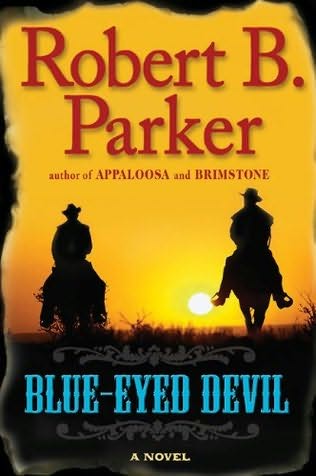

Kleypas - nice but innacurate. dude is sexy and since the title centers around our sexy hero there ought to be a sexy dude on the cover. however, this book is set almost exclusively in Houston and Dallas. i've spent lots of time in Houston and some in Dallas. this road does not exist. hell, it probably doesn't even exist on the outskirts of Houston. regardless, it certainly does not put one in mind of the book's setting.
Parker - nice cover. i'm immediately put in a western mindframe. excellent use of the sillohoute. i especially like how one dude is clearly facing forward and the other is looking at facing-forward guy. FFG is easy to see as Virgil. The other would be Everett, the reader's window into the story. it's completely appropriate that he's looking at Virgil as he often does in the story. and not just looking at but looking to Virgil.
The most eye-catching portion of the covers is the author's name. Both of these authors have a body of successful work to their names and the covers rely as much (or more) on the author's name to sell the book as on the cover art.
Verdict: Point to Parker
Synopses:
Kleypas - Haven comes from an affluent and controlling family. When she decides to go against their wishes and marry the man of her dreams things don't turn out quite like she anticipated. She's trying to put her life back together and isn't so sure Hardy Cates is the right way to start.
Parker - Cole and Hitch are back in Appaloosa and the new police chief isn't necessarily happy that the former keepers of the law are back. Cole and Hitch are happy to stick to themselves but when the chief of police starts employing some shady tactics they feel compelled to get involved.
Verdict: Push
Place in their respective worlds:
Kleypas is a stand alone but characters from Sugar Daddy featured (and I, for one, am glad as I definitely wanted to know what happened to Hardy after SD)
Parker is the fourth book in the Cole/Hitch series but the first one I've read (and, actually, only the second Parker novel I've read - talked about the other here)
Verdict: Point to Kleypas (but only because I'm going through an anti-series phase)
Similarities:
Title.
They are both told in first person perspective.
They both feature violence; though one is violence used for unethical control and one is violence used for order (albeit, self-determined order).
Differences: Abundant.
(see below)
Writing Style:
The styles featured here could not be more different. Kleypas is told heavily as a "and then this happened" recounting from Haven. There are even segments where the reader is taken step by step through her thinking process as she recovers from the trauma of her first marriage. The motivations and feelings of each character are clear with very little room for interpretation.
Parker's style, on the other hand, makes spare seem like an over-statement. As a reader who enjoys an author who will put the story in my hands, I liked this a lot. I found myself reading passages (especially conversations) over and over with different interpretations. It made me pay attention to even the smallest of details as possible clues as to why characters did what they did. The book is pretty short anyway, but with such stingy writing there was no way my usual skimming would come into play. I had to use each word to paint the pictures and I liked that. I wish I had that experience more often.
Verdict: Point to Parker
Characterization:
From the description above of the writing styles you can probably guess a little about the characterization. It was certainly more thorough in Kleypas (if not exactly subtle) but with Parker you have to go deeper to find the characters. Again, I like that! When I finished Kleypas I didn't need to read any more about Haven and Hardy (oh! I just noticed that! hmmm) but there is still much to learn about Cole and Hitch which might get me to actually seek out other books in the series.
Verdict: Push
Plot/Story:
Both books are straightforward tales of significant events in the characters' lives. Neither story reached me on a level beyond "heh, that's entertaining" so I'd say that each story is mostly targeted to those readers already interested in the set-up.
Verdict: Push
What I Liked:
In Kleypas I liked that the reality of, and recovery after, domestic violence was a part of the story. I feel that it could be helpful to those that find themselves in an abusive situation and can't quite see their way clear.
In Parker I liked the spare writing that left much of the story in the reader's hands. That puts it in the category of books I'm not editing while I read. I wish more books were like this.
What I Didn't Like:
In Kleypas it's not really clear why Hardy is interested in Haven. I mean, I know she's cool because I'm hanging out in her perspective but why did Hardy think she was cool?
In Parker I didn't like the limited view of Allie. I spent a lot of time reviewing interactions with Allie and I just couldn't figure what she was bringing to the table.
Verdict:
At the end of the day each book got me thinking but neither stayed with me after I was done. I enjoyed the novelty of such different books having the same title but that's about all I'm taking away.
ratings:
Kleypas: 3 of 5 stars
Parker: 3 of 5 stars
Sunday, September 12, 2010
Series Snafus
My seemingly non-stop whining about series over the last 6 months and Apprentice Writer's recent post inspired me to turn whining into articulation a blog post and make a list of what it is that drives me bonkers in a series.
Side note: I had been meaning to do this with writing pet peeves in general but turns out a pretty good list already exists. To this I would add: misuse of reflexive pronouns, overuse of "twitch" to indicate humor by lip movement, and overuse of the word "sardonic." In fact, I believe I will never use the word again. Ever. Not once. I don't care how sardonic someone is I will find some other way to express it (ok, clearly that was the actual last use of the word).
And a question: what is the name for this? When not falling prey to the Writing Ticks, I describe writing as deft. In the realm of writing what is the opposite of deft?
Ok, counting down to my top series snafu
6. The Increasing Unlikelyhood that Any of This is Possible
Item 6 rears its ugly head in two ways. Way One: we're 11(000) books in to a series and everything has happened to every recurring character. After a while I just don't buy it. When one character has now had more excitement than any 100 people combined it's time to end it - well, probably past time but whatevs. (This error is especially egregious in PI novels. You know, you can only say that most of your time is spent running records checks so many times before the dead bodies start to make me doubt your statement.)
Way Two: reader loyalty is used as a bouy to suspension of disbelief and we are expected to go along with the impossible because, well, shucks, it's Character A and whacky things just can't help happening whenever Character A happens by. I realize that we're not all queuing up to read boring books but you've got to make me believe that what is happening would happen. If not, I don't care how much I've liked your previous work, I'm checking out and not coming back.
5. Recycled Vocabulary
I appreciate style but it quickly loses substance when a series author begins recycling descriptions verbatum. English has much variety. Please explore it.
4. The Recycled Plot/Romance Impediment/Twist
Now this is interesting because it's not like there are a ton of plots out there and I read the same stories over and over. BUT! I read them with new characters in new places with new perspectives. I'm not interested in watching the same characters in a recycled a plot. If I'm going to read the same story I want to meet new people.
3. The Recycled Character Arc
A character that learns the same lessons book after book after book is Made of Stupid and not interesting.
2. The Character Reversal
It is a major party foul to change character attributes (often essential to a previous book's arc or plot) for reasons of plot only. I am more than happy to experience growth with a character but it must stem naturally from events and not simply move things along in subsequent books.
1. Blowing Your Wad
And here we are at the big one! How I despise the re-cap!!! The re-cap puzzles me for multiple reasons. If I am a loyal reader, I do not need your re-cap. If I am a new reader, the re-cap is a waste. Let's say you (the author) are in book three. That means you have two books of backstory! Two books of world-building background! Two books of character outline! What a wealth of information at your fingertips for book three. Why oh why would you blow all that in the first few chapters? This is information that can (and probably will) inform most of what the characters say and do. It breathes in the background hinting at a full and realistic world. Again, why blow this at the beginning? If you have an established character why would you want to do a two paragraph run-down on that character when, instead, you know this character so well that every word and action will come naturally from all you know? I don't want an explanation, I want to see that character being that character! And if you are re-capping past events, again, I must ask why? So often they are not essential to the current story so you have just constructed a nice little "road work ahead" sign that has slowed me down, taken me out of the current story, and hit me over the head with the fact that I'm reading a series. Yuck!
The question for me becomes, why is the re-cap so ubiquitous? It must be serving a purpose that I am not seeing. But what is that purpose? As a series reader have I suddenly been rendered incapable of following the current story or current character without extensive background? Do authors prefer to not incorporate past information in a natural way? Is the re-cap easier? Is it satisfying some desire in readers that I clearly don't share? Gah! So much confusion for me!
Any ideas on the purpose of the re-cap?
Any series nit picks you'd like to add?
Side note: I had been meaning to do this with writing pet peeves in general but turns out a pretty good list already exists. To this I would add: misuse of reflexive pronouns, overuse of "twitch" to indicate humor by lip movement, and overuse of the word "sardonic." In fact, I believe I will never use the word again. Ever. Not once. I don't care how sardonic someone is I will find some other way to express it (ok, clearly that was the actual last use of the word).
And a question: what is the name for this? When not falling prey to the Writing Ticks, I describe writing as deft. In the realm of writing what is the opposite of deft?
Ok, counting down to my top series snafu
6. The Increasing Unlikelyhood that Any of This is Possible
Item 6 rears its ugly head in two ways. Way One: we're 11(000) books in to a series and everything has happened to every recurring character. After a while I just don't buy it. When one character has now had more excitement than any 100 people combined it's time to end it - well, probably past time but whatevs. (This error is especially egregious in PI novels. You know, you can only say that most of your time is spent running records checks so many times before the dead bodies start to make me doubt your statement.)
Way Two: reader loyalty is used as a bouy to suspension of disbelief and we are expected to go along with the impossible because, well, shucks, it's Character A and whacky things just can't help happening whenever Character A happens by. I realize that we're not all queuing up to read boring books but you've got to make me believe that what is happening would happen. If not, I don't care how much I've liked your previous work, I'm checking out and not coming back.
5. Recycled Vocabulary
I appreciate style but it quickly loses substance when a series author begins recycling descriptions verbatum. English has much variety. Please explore it.
4. The Recycled Plot/Romance Impediment/Twist
Now this is interesting because it's not like there are a ton of plots out there and I read the same stories over and over. BUT! I read them with new characters in new places with new perspectives. I'm not interested in watching the same characters in a recycled a plot. If I'm going to read the same story I want to meet new people.
3. The Recycled Character Arc
A character that learns the same lessons book after book after book is Made of Stupid and not interesting.
2. The Character Reversal
It is a major party foul to change character attributes (often essential to a previous book's arc or plot) for reasons of plot only. I am more than happy to experience growth with a character but it must stem naturally from events and not simply move things along in subsequent books.
1. Blowing Your Wad
And here we are at the big one! How I despise the re-cap!!! The re-cap puzzles me for multiple reasons. If I am a loyal reader, I do not need your re-cap. If I am a new reader, the re-cap is a waste. Let's say you (the author) are in book three. That means you have two books of backstory! Two books of world-building background! Two books of character outline! What a wealth of information at your fingertips for book three. Why oh why would you blow all that in the first few chapters? This is information that can (and probably will) inform most of what the characters say and do. It breathes in the background hinting at a full and realistic world. Again, why blow this at the beginning? If you have an established character why would you want to do a two paragraph run-down on that character when, instead, you know this character so well that every word and action will come naturally from all you know? I don't want an explanation, I want to see that character being that character! And if you are re-capping past events, again, I must ask why? So often they are not essential to the current story so you have just constructed a nice little "road work ahead" sign that has slowed me down, taken me out of the current story, and hit me over the head with the fact that I'm reading a series. Yuck!
The question for me becomes, why is the re-cap so ubiquitous? It must be serving a purpose that I am not seeing. But what is that purpose? As a series reader have I suddenly been rendered incapable of following the current story or current character without extensive background? Do authors prefer to not incorporate past information in a natural way? Is the re-cap easier? Is it satisfying some desire in readers that I clearly don't share? Gah! So much confusion for me!
Any ideas on the purpose of the re-cap?
Any series nit picks you'd like to add?
Friday, September 3, 2010
Sympathy for the Devil by Kent Anderson
Title: Sympathy for the Devil
Author: Kent Anderson
Publisher: Bantam (2000), originally published in 1987
Quick aside - the copyright page says: "This edition contains the complete text of the original hardcover edition. NOT ONE WORD HAS BEEN OMITTED." I've never noticed a note like this before. Is this common? Is there some secret, word-omitting publication history for this book?
Sympathy for the Devil is set during the Vietnam War and, in three parts, tells the story of Special Forces Sergeant Hanson. The first part opens towards the end of Hanson's first tour and covers his attempt at life back in the States. The second part starts with Hanson, a college student, at the induction center after being drafted and his first days in-country. The third part focuses mainly on his second tour in Vietnam.
It was an interesting choice to introduce the reader to Hanson as an already hardened soldier and then swing back to who he was before. I certainly felt I had his character well in hand going into Part 2 but it became apparent that Anderson planned on using the entire book in his portrayal of Hanson. I liked that as a story-telling device and on a personal level for how it felt much like the way ya get to know people. Like when you've know someone for years and then you're suddenly surprised by new information.
The narrative had a rather clumsy feel to it so that I never settled into events, which is either just the author's style or a brilliant technique illustrative of the madness of war and such. And there is much madness in this book. This isn't one of those depressing war books punctuated by moments of humanity and hope. It's one of those depressing war books punctuated by moments of crazy and the ineffectiveness of military bureaucracy.
While Hanson's thoughts on what and who are around him are pretty clear there's also an over-arching philosophy and mode of thought portrayed by the book itself. Since Anderson was a Special Forces Sergeant in Vietnam I'm curious as to how reflective of his own experiences the book is. (Night Dogs is his follow-up to this which features Hanson as a police officer, also like Anderson which makes me think maybe this is largely the author's personal story.) Regardless, it certainly gives a peep into a part of people not often seen in everyday life. What I found just as interesting as the human aspect of the novel was the examination of political and administrative inertia. Such inertia is often more dangerous than any enemy.
You spend most of the book with Hanson but he isn't always accessible. Then these small moments come by that give a window into what he is feeling. Anderson's ability to pinpoint and lay bare these moments is extremely satisfying.
Premature crow's-feet set off her startlingly clear green eyes that made Hanson almost dizzy when he met them, embarrassing them both in a moment of unexpected sexual contact.
Anderson also includes moments of the absurd:
He looked at the ticket and began to laugh. He wadded up the little piece of green tissue paper and was about to throw it away, then realized that he'd need it as proof when he told Quinn and Silver that he'd gotten a speeding ticket.
And he's great at expressing threat and the extraordinary in a way that makes real what, for most of us, borders on the unreal:
Sixth sense is only the other five senses fine-tuned to threat. A shift in the rhythm of the silence that opens your eyes. A shudder in the pattern of shadow. The hint of some smell that brings your head up. Separately they would mean nothing, but together they are enough to lift the hair on your neck, to stir little bubbles of dread deep in the back of your brain, all of them forming like a forgotten name, right on the tip of your tongue. A group of men moving through the dark with plans to kill you gives off an energy you can feel if you pay attention to what your senses tell you.
I have a long and complicated relationship with war-centered literature (and movies). I enjoy it for many reasons, including basic education in topics I'm not familiar with and my desire for witnessing history and specialized training, but it also tears me up emotionally. I would read (and watch) more war drama but I don't have the emotional fortitude. I'd be a wreck. I often am a wreck after reading this stuff, whether it be fiction or non-fiction. However, I always enjoy the possibilities for endless discussion of socio-political topics, not to mention the idea of basic humanity. I also find I'm often frustrated by my inability to read it more critically. I'm not a soldier (couldn't be, actually, as I lack even the most basic qualities for what is required in one to be a soldier) or close to anyone who has experienced serious combat so I feel like I can never wholly believe or disbelieve what I am reading. Possibly that is simply an unexpected but perfect mirror for war in general. However, no matter how I feel after an exploration into a war story I continue to wish we weren't quite so eager to pursue wars. They are a devastating and nasty business.
rating: 4 of 5 stars
Two parting questions:
What is your favorite story that involves war?
Anyone want to suggest some war stories that do not revolve around the "boy scout" soldier persona or the soldier that has found a home in war because life has been reduced to its most basic tenet: survival? These seem to be what I encounter most in fiction.
"My Cheevos!"
The price increase for Xbox Live subscriptions will probably go unnoticed in many (ok, most) households but this one takes notice. And Dr M is not alone!
The Ultimatum
The Ultimatum
Monday, August 30, 2010
The Spymaster's Lady & My Lord and Spymaster by Joanna Bourne
Titles: The Spymaster's Lady
My Lord and Spymaster
Author: Joanna Bourne
Publisher: Berkley Sensation (2008)
The Spymaster's Lady is one of my top books read this year. I heart this book with the biggest, mushiest, lurviest heart there is and can't say enough good things about it. As one might expect, I then went into My Lord and Spymaster with some pretty high expectations. Why don't I give a little blurb for each and then some details on my thoughts.
In The Spymaster's Lady, Annique Villiers and Robert Grey find themselves imprisoned in the same French jail cell. Annique, a French spy, because it is thought she will betray her country and Robert because he is an English spy. A Very Bad Man threw them in jail and Annique plans to get them out of there as fast as possible. What she does not know is that Robert has come to France specifically to find her and then dabble in a little absconding. There's a lot more to this plot than the little I'm sharing here but it unfolds so beautifully - with some very nice surprises - that I don't want to share more than a brief introduction. I'll help myself to an old stand-by and reassure you that it'll "keep you guessing until the end."
Let me just get the unfortunate flaw out of the way now so I can focus on all the awesome: the villain is pretty sucky. I don't just mean that he sucks because he's bad but that his character is not so very well done. I called him a Very Bad Man because that's about all there is to him. His Badness is even expressed in not very creative ways. Thankfully his bits are separated into short chapters that I skimmed the first time and skip altogether in subsequent reads (and I've probably read this book 4 times in the last few months). Otherwise this book is one shining gem of book greatness. I honestly can't say enough about how awesome this book is. The plot is exciting and nerve-wracking, the characters (both main and secondary - excepting villain, see above) are fantastic and perfectly depicted, the romance is beset with believable impediments (a must in sgwordy's world) but the h and h are also very authentic as a pair, and did I mention the awesome plot? the awesome characterization? and the awesome hero and heroine? Oh, I did? Then don't let me skimp on the writing which is just gorgeous! I mean, just a total joy-to-experience lovely with very impressive depictions of languages and dialect.
Ok, so maybe now you can see with what expectations I went into my second Bourne novel. In My Lord and Spymaster Jess Whitby's father has been accused of treason. To prove his innocence she'll have to employ her considerable intelligence and all her cunning from her old life on the streets. As she attempts togather steal some information from Captain Sebastian Kennet there is an attack on her life. He helps her to escape and, as a favor to a friend of hers, takes her into his protection (don't worry - it makes sense with the plot even though my brief description sounds weird). What she doesn't know is that he is the one who gathered the evidence against her father.
I'm going to start with what I liked and then make a few comments as to why I didn't enjoy this one as much as the other. First off, AND ALL SERIES WRITERS PLEASE TAKE NOTE, a couple characters from TSL show up in MLaS and I was not subjected to the recap/character outline that just screams (while beating you over the head) that a book is part of a series. And what blissful heaven it was. When the first familiar character showed up, I literally cringed as I waited for the laundry list of what is currently in the cannon, as it were, about the character. And, oh joy, it never happened. In what can only be described as a breath of fresh air, the familiar characters showed up, did their jobs, were as awesome as they were before, and acted just as I would expect from previous time spent with them. Thank you, Ms. Bourne!!!!! Thank you so very much for letting your characters speak for themselves! Thank you, thank you, thank you! (As you can see the "laundry list" technique is a huge pet peeve of mine.) The writing is as lovely as in TSL and the characters are, once again, very well done. Where MLaS lost me (and this should be viewed as a relative term because I still liked the book and it's on my Keeper shelf) was its lack of follow-through with plot. The plot is quite good with lots of what-ifs and various characters that might be "whodunit" but it still fell rather flat for me. I didn't feel like I was following its twists and turns but, instead, I was just hanging out with the characters as they moved from one dangerous situation to another while I waited for the end. Also, it's a romance, we know certain things about the romance formula that make several endings impossible. Since the impediment to our h and h being together relied very heavily on what I thought was one of the impossible endings I didn't believe there was anything really standing in the way of them being together.
So, to get the maximum enjoyment possible from these two novels I suggest starting with MLaS so you don't have the crazy high expectations going into it. I'm sure I would have enjoyed it more had I not read TSL first. However, no matter what, you really must read The Spymaster's Lady. It's just too damn good to miss!
ratings:
TSL - 4 of 5 stars
MLaS - 3 of 5 stars
My Lord and Spymaster
Author: Joanna Bourne
Publisher: Berkley Sensation (2008)
The Spymaster's Lady is one of my top books read this year. I heart this book with the biggest, mushiest, lurviest heart there is and can't say enough good things about it. As one might expect, I then went into My Lord and Spymaster with some pretty high expectations. Why don't I give a little blurb for each and then some details on my thoughts.
In The Spymaster's Lady, Annique Villiers and Robert Grey find themselves imprisoned in the same French jail cell. Annique, a French spy, because it is thought she will betray her country and Robert because he is an English spy. A Very Bad Man threw them in jail and Annique plans to get them out of there as fast as possible. What she does not know is that Robert has come to France specifically to find her and then dabble in a little absconding. There's a lot more to this plot than the little I'm sharing here but it unfolds so beautifully - with some very nice surprises - that I don't want to share more than a brief introduction. I'll help myself to an old stand-by and reassure you that it'll "keep you guessing until the end."
Let me just get the unfortunate flaw out of the way now so I can focus on all the awesome: the villain is pretty sucky. I don't just mean that he sucks because he's bad but that his character is not so very well done. I called him a Very Bad Man because that's about all there is to him. His Badness is even expressed in not very creative ways. Thankfully his bits are separated into short chapters that I skimmed the first time and skip altogether in subsequent reads (and I've probably read this book 4 times in the last few months). Otherwise this book is one shining gem of book greatness. I honestly can't say enough about how awesome this book is. The plot is exciting and nerve-wracking, the characters (both main and secondary - excepting villain, see above) are fantastic and perfectly depicted, the romance is beset with believable impediments (a must in sgwordy's world) but the h and h are also very authentic as a pair, and did I mention the awesome plot? the awesome characterization? and the awesome hero and heroine? Oh, I did? Then don't let me skimp on the writing which is just gorgeous! I mean, just a total joy-to-experience lovely with very impressive depictions of languages and dialect.
Ok, so maybe now you can see with what expectations I went into my second Bourne novel. In My Lord and Spymaster Jess Whitby's father has been accused of treason. To prove his innocence she'll have to employ her considerable intelligence and all her cunning from her old life on the streets. As she attempts to
I'm going to start with what I liked and then make a few comments as to why I didn't enjoy this one as much as the other. First off, AND ALL SERIES WRITERS PLEASE TAKE NOTE, a couple characters from TSL show up in MLaS and I was not subjected to the recap/character outline that just screams (while beating you over the head) that a book is part of a series. And what blissful heaven it was. When the first familiar character showed up, I literally cringed as I waited for the laundry list of what is currently in the cannon, as it were, about the character. And, oh joy, it never happened. In what can only be described as a breath of fresh air, the familiar characters showed up, did their jobs, were as awesome as they were before, and acted just as I would expect from previous time spent with them. Thank you, Ms. Bourne!!!!! Thank you so very much for letting your characters speak for themselves! Thank you, thank you, thank you! (As you can see the "laundry list" technique is a huge pet peeve of mine.) The writing is as lovely as in TSL and the characters are, once again, very well done. Where MLaS lost me (and this should be viewed as a relative term because I still liked the book and it's on my Keeper shelf) was its lack of follow-through with plot. The plot is quite good with lots of what-ifs and various characters that might be "whodunit" but it still fell rather flat for me. I didn't feel like I was following its twists and turns but, instead, I was just hanging out with the characters as they moved from one dangerous situation to another while I waited for the end. Also, it's a romance, we know certain things about the romance formula that make several endings impossible. Since the impediment to our h and h being together relied very heavily on what I thought was one of the impossible endings I didn't believe there was anything really standing in the way of them being together.
So, to get the maximum enjoyment possible from these two novels I suggest starting with MLaS so you don't have the crazy high expectations going into it. I'm sure I would have enjoyed it more had I not read TSL first. However, no matter what, you really must read The Spymaster's Lady. It's just too damn good to miss!
ratings:
TSL - 4 of 5 stars
MLaS - 3 of 5 stars
Thursday, August 26, 2010
The Power of the Dog by Don Winslow
So I'm not actually going to write up a review of my own because le0pard13's review at Lazy Thoughts From a Boomer is better (and more informed) than anything I could come up with so click here for an excellent review.
I do have a couple comments, though:
1. Read this book! It is awesome, mind-blowing, tense, illuminating, heart-breaking, and unputdownable.
2. My back aches from how wound up with tension I was for the last ~100 pages.
3. I owe Michael endless favors for mentioning this book to me. (Seriously! Cash in anytime, lp13, my debt is great!)
4. I am more convinced than ever that the War on Drugs ought to be fought in treatment centers rather than bullet-proof vests.
5. I recently read a book with a page-long acknowledgments section and a two page author's note and the book was merely historically placed fiction. This book spans ~30 years, multiple countries, politics, drug cartels, the cold war, etc and there is not one tiny peep in the book or on the author's website re his research? Hunh???? Where can I find more information on this book?
6. The communism domino theory thing truly is one of the stupider theories this world has suffered from.
7. Just when you think the internet is bereft of surprises you find a table detailing the current leaders and founders of Mexico's drug cartels on Wikipedia. On Wikipedia!!!!! My gosh, I love the internet!
8. Read this book!
rating: 5 of 5 stars
I do have a couple comments, though:
1. Read this book! It is awesome, mind-blowing, tense, illuminating, heart-breaking, and unputdownable.
2. My back aches from how wound up with tension I was for the last ~100 pages.
3. I owe Michael endless favors for mentioning this book to me. (Seriously! Cash in anytime, lp13, my debt is great!)
4. I am more convinced than ever that the War on Drugs ought to be fought in treatment centers rather than bullet-proof vests.
5. I recently read a book with a page-long acknowledgments section and a two page author's note and the book was merely historically placed fiction. This book spans ~30 years, multiple countries, politics, drug cartels, the cold war, etc and there is not one tiny peep in the book or on the author's website re his research? Hunh???? Where can I find more information on this book?
6. The communism domino theory thing truly is one of the stupider theories this world has suffered from.
7. Just when you think the internet is bereft of surprises you find a table detailing the current leaders and founders of Mexico's drug cartels on Wikipedia. On Wikipedia!!!!! My gosh, I love the internet!
8. Read this book!
rating: 5 of 5 stars
Wednesday, August 25, 2010
GS
Worth your time!
You've got Dr M to thank for this one and be sure you're not drinking anything when you surf over because it'll soon be coming out your nose.
(again, what is with me and the 180s on post topics/seriousness?)
You've got Dr M to thank for this one and be sure you're not drinking anything when you surf over because it'll soon be coming out your nose.
(again, what is with me and the 180s on post topics/seriousness?)
Monday, August 23, 2010
My First Nora Roberts
Title: Born In Ice
Author: Nora Roberts
Publishers: Jove (1995)
I have avoided Nora Roberts for one reason: I'm deeply suspicious of any author that needs several pages to list her/his novels. Perhaps it's unfair of me (or simply insulting (or plain jealousy)) but to be that prolific and still write good books seems so improbable as to be statistically impossible. Born In Ice, while much better than I would have expected from someone who appears to write novels with factory-like output, was not good enough to change my suspicious mind. (NR fans, please feel free to set me right! I'm always interested in being pointed to the good works - easy to miss in a three page list, methinks.) Anyway, synopsis...
Brianna runs a bed and breakfast in Ireland. It's the slow season and she has only one guest. He is an American author finishing up his latest novel. Hmm, well, actually that's about it. Huh. It's not nearly as boring as that description makes it sound, though now I'm starting to see why there's just a picture of Roberts on the back cuz how does one come up with more back copy than what I've just said? Huh. Anyway... so Grayson's working on his book and Brianna's doing her thing of running the B&B. Brianna, by the way, is awesome! If I had half the skills she has I think it'd be ~100x as many as I currently have. Holy damn, she is one talented lady! She's also excellent at dealing with Grayson's moodiness. She's got a great way of cutting right to the issue and making a person feel pretty small for being a jerk. Grayson's actually not a bad guy he's just up and down depending on how the writing is going. (I actually enjoy when a character is a writer as I think it's funny to hear authors describe their professions.)
This is another of those romances that didn't work for me because everything was too easy. Sure, Grayson had to overcome a deeply personal fear to make a change in his life but there wasn't one single moment when I didn't think he would. Also, Grayson is one of those mega-successful authors with money coming out of his ears* so Brianna, who has to scrimp and save for every improvement, gets insta-cash cuz he's around. I'm certainly happy for her but, again, too easy.
There's really nothing particularly wrong with the story, or the protags who are both decent and likable, it's just that I never had any sort of investment in it. I could have put it down at any time and not once worried about what happened to anyone. What I ended up enjoying the most was Grayson interacting with people when they mentioned his work (actually Grayson is a pretty funny guy so he often had lines that made me giggle). To me this is a bad sign. It's a romance, shouldn't my favorite conversations include the protags? I mean, at least some of the time? So anyway, this one does not get a huge recommendation from me and it wouldn't surprise me if I never read another Roberts. However, I will exit with a quote from some random guy to Grayson about his novels:
Awe. Some! No kidding, it's never in the way! In fact, it's paving the way to my bank account. :)
rating: 3 of 5 stars
(a rating of 3 really is the least informative isn't it?)
**I've always wondered at the possible similarities in horse racing success and author success. There's something like 37,000 thoroughbreds registered every year (in North America) and less than 5% of them end up making the big bucks. Percentages go up a little if you're talking just breaking even but the mega-bucks are hard to come by.
Author: Nora Roberts
Publishers: Jove (1995)
I have avoided Nora Roberts for one reason: I'm deeply suspicious of any author that needs several pages to list her/his novels. Perhaps it's unfair of me (or simply insulting (or plain jealousy)) but to be that prolific and still write good books seems so improbable as to be statistically impossible. Born In Ice, while much better than I would have expected from someone who appears to write novels with factory-like output, was not good enough to change my suspicious mind. (NR fans, please feel free to set me right! I'm always interested in being pointed to the good works - easy to miss in a three page list, methinks.) Anyway, synopsis...
Brianna runs a bed and breakfast in Ireland. It's the slow season and she has only one guest. He is an American author finishing up his latest novel. Hmm, well, actually that's about it. Huh. It's not nearly as boring as that description makes it sound, though now I'm starting to see why there's just a picture of Roberts on the back cuz how does one come up with more back copy than what I've just said? Huh. Anyway... so Grayson's working on his book and Brianna's doing her thing of running the B&B. Brianna, by the way, is awesome! If I had half the skills she has I think it'd be ~100x as many as I currently have. Holy damn, she is one talented lady! She's also excellent at dealing with Grayson's moodiness. She's got a great way of cutting right to the issue and making a person feel pretty small for being a jerk. Grayson's actually not a bad guy he's just up and down depending on how the writing is going. (I actually enjoy when a character is a writer as I think it's funny to hear authors describe their professions.)
This is another of those romances that didn't work for me because everything was too easy. Sure, Grayson had to overcome a deeply personal fear to make a change in his life but there wasn't one single moment when I didn't think he would. Also, Grayson is one of those mega-successful authors with money coming out of his ears* so Brianna, who has to scrimp and save for every improvement, gets insta-cash cuz he's around. I'm certainly happy for her but, again, too easy.
There's really nothing particularly wrong with the story, or the protags who are both decent and likable, it's just that I never had any sort of investment in it. I could have put it down at any time and not once worried about what happened to anyone. What I ended up enjoying the most was Grayson interacting with people when they mentioned his work (actually Grayson is a pretty funny guy so he often had lines that made me giggle). To me this is a bad sign. It's a romance, shouldn't my favorite conversations include the protags? I mean, at least some of the time? So anyway, this one does not get a huge recommendation from me and it wouldn't surprise me if I never read another Roberts. However, I will exit with a quote from some random guy to Grayson about his novels:
"I'll have to get it out of the way and tell you I'm a big fan."
"It's never in the way."
Awe. Some! No kidding, it's never in the way! In fact, it's paving the way to my bank account. :)
rating: 3 of 5 stars
(a rating of 3 really is the least informative isn't it?)
**I've always wondered at the possible similarities in horse racing success and author success. There's something like 37,000 thoroughbreds registered every year (in North America) and less than 5% of them end up making the big bucks. Percentages go up a little if you're talking just breaking even but the mega-bucks are hard to come by.
Friday, August 20, 2010
A Scanner Darkly by Phlip K. Dick

Author: Philip K. Dick
Publisher: Vintage Books (1977)
le0pard13 and I are back again for a look at a book and its adaptation into movie form. I think A Scanner Darkly was a suggestion (yes, we take suggestions! anything you'd like to see get the joint treatment?) from a commenter at Lazy Thoughts From a Boomer. I sure am glad for the suggestion because I really liked the book and I enjoyed the movie, as well. So let's get to it.
Click here for Michael's A Scanner Darkly Film Review
Robert Arctor is an undercover police officer in Los Angeles. When undercover, he's a small time drug dealer called Robert Arctor. At the office he's disguised in a scrambler suit, as are all his colleagues, and called Fred. As Arctor, he's trying to make his way up the dealer ladder to find the source of Substance D, a powerful narcotic that eventually leads to a split in the user's brain. As Fred, he has been assigned to tail Arctor. The story centers around his increased dependence on Substance D undermining his ability to maintain the two identities.
The story addresses a pretty serious topic. But before we get too focused on the serious let's have a laugh about Arctor's weird hard-on for pistol whipping (there was a time at the beginning where I thought this was going to be a per chapter threat!) and PKD's odd dialogue style totally working for a book about a bunch of people on drugs. Seriously! It's like his dialogue style found its calling. Awesome! And if you didn't click on the book link above be sure to eventually have a visit because the second cover photo is to bust-a-gut for [now included above]. Oh the hair! The stache!
Quick note about the druggies: I'm not a huge fan of books/movies about people doing drugs. I have a lot of interest in the infrastructure of the drug trade (and its relationship to law enforcement) but stories that focus mainly on those doing drugs - and their drug-induced behavior - are of little interest to me. There was a portion of the movie that totally lost me as a viewer since I was just sitting there watching druggies be druggies, but it wasn't too long and the book was much more interesting during those parts. Actually, the movie is a remarkably faithful adaptation but the internal processes of the characters - esp Arctor - are, obviously, lost in the film. It's the windows into the users' minds that made the book more enjoyable for me in those parts. Otherwise they both do a great job of introducing the very interesting concepts of dual identities and the value of the individual vs. the group within the backdrop of a relevant societal issue.
I've always loved PKD stories because of his cool ideas but he really steps it up for this one because it's a fantastic idea laced with dead-on observations about people (as all the best sci-fi is:). Arctor often struggles with his genuine compassion for those he is tailing and his feelings are humorously illuminated as he recounts hearing this phrase from a non-using friend of his drug crowd:
If I had known it was harmless I would have killed it myself.
Besides the fact that the phrase itself makes one pause to think of how often this theme plays out in human history, Arctor's response - and what it means to the dual life he is leading - is one helluva passage. Even as he struggles with this there's no doubt in his mind that he will bust those that he is ordered to bust. Then, he begins to suspect one of his friends of a revenge narc and thinks he's being observed, ironically he's disgusted by the thought of someone acting like they are your friend just to get dirt on you (double irony, of course, is that he is being observed but only by him).
As mentioned above, the illustration of Arctor's conflict, and actually many of the conflicts and problems in the story, is humorous but it's of the bittersweet and ironic variety. Like if you didn't laugh at it you just might cry a little. I find it's one of the more successful aspects of the book. You're going along, enjoying yourself, getting totally into the story and suddenly laughing out loud. Then you peel back the humorous surface and wonder how it is you managed to laugh at the situation. Very powerful and engaging stuff.
On the face of it, this is a simple story of a rather odd undercover set-up. But the surface really is only the beginning. There is so much going on in this book! There's a hint of this before you even start reading. For exploration of this hint, you'll need to pull out what I think is the most successful publishing endeavor ever, and certainly one of the most influential books in the world, the Bible. Flip on over to 1 Corinthians 13 and read through one of the Bible's more popular chapters (and lest we overlook; oft-
NIV - 1 Cor 13:12 Now we see but a poor reflection as in a mirror; then we shall see face to face. Now I know in part; then I shall know fully, even as I am fully known.
New KJV - 1 Cor 13:12 For now we see in a mirror, dimly, but then face to face. Now I know in part, but then I shall know just as I also am known.
KJV - 1 Cor 13:12 For now we see through a glass, darkly; but then face to face: now I know in part; but then shall I know even as also I am known.
Now, I've always found 1 Cor 13 rather poetic and layered but holy hellfire that verse 12 is just packed and so super awesome as relates to A Scanner Darkly. Ok, enough alluding, let's get on with it.
On the surface you've got the plight of addicts, the difficulty of the dual life of an undercover cop, and the often hilarious attempts of Arctor to woo Donna. A constantly recurring theme just under this is the rights of an individual vs. the health of society at large. Go a little bit deeper and the title, which at first speaks simply to leading a dual life, fairly hums across every chapter, line, and theme. Now I know in part; but then shall I know even as also I am known. That says it all and if I were to really get into this, massive spoilers would rear their ugly heads. I'd rather leave the finer details for the reader to discover than ruin them. I don't want to say too much about the movie here but, even though it's a fantastic adaptation (including word for word conversations), you really miss a lot of what is best about this story if you don't read the book.
It's obvious (and not just because of the author's note) that PKD isn't trying to point any fingers or make any judgments. He took a lifestyle that had an immense effect on his own life, threaded it with a great idea, then proceeded to highlight the multiple realities of drug production, use, and prevention with a keen eye for humanism. It really is one damn fine tale.
I've focused mostly on what I liked but there were a couple passages that centered around a topic that always gets my hackles up. This was the notion of a lost golden age. Like things are so shit right now but "a long, long time ago" there wasn't so much gray and justice and wisdom always aligned and blah de freaking blah! I can't stand this theme! I'm still waiting for the golden age. Would anyone seriously trade being born now for being born sometime in the past? Give me a break! Taking just being female as an example there are many Ages (and decades none too distant) that did not look kindly upon the lack of a penis. Plus, if you're constantly looking backward for a fabled golden age you certainly can't be looking forward to a time when we might truly attain an age of equality and sustainability.
But, really, that's a small part of the overall story and other quibbles I have are pretty small. This is a great book that is so worth your time. Pick it up for the awesome story but read it attentively for the rewards of closer inspection.
A few good lines:
Fred [Arctor in scramble suit]: If you boys are psychologist types and you've been listening to my endless debriefings with Hank, what the hell is Donna's handle? How do I get next to her? I mean, how is it done? With that kind of sweet, unique, stubborn little chick?
"Each girl is different," the seated deputy said.
"I mean approach her ethically," Fred said. "Not cram her with reds and booze and then stick it into her while she's lying on the living-room floor."
"Buy her flowers," the standing deputy said.
"What?" Fred said, his suit-filtered eyes opening wide.
Now my [auto] insurance rates will go up... In this world you pay for tilting with evil in cold, hard cash.
It requires the greatest kind of wisdom to know when to apply injustice. How can justice fall victim, ever, to what is right? How can this happen?
"Life asks an awful lot."
Don't forget to check out the movie review! And, as always, many thanks to Michael for the fun of joint analysis.
rating: 4 of 5 stars
Click here for an index of the joint post series
Wednesday, August 18, 2010
My Life in Books Meme
I was inspired to play along!
In high school I was: Not Quite a Lady (Loretta Chase)
People might be surprised I’m: Looking for Rachel Wallace (Robert B. Parker)
I will never be: Sleepless (Charlie Huston) **
My fantasy job is: Eagle of the Ninth (Rosemary Sutcliff) **
At the end of a long day I need: High Heat, To Say Nothing of the Dog (Tim Wendel, Connie Willis) **
I hate it when: Nowhere Is A Place (Bernice L. McFadden) **
Wish I had: The Maltese Falcon (Dashiell Hammett) **
My family reunions are a: Gaudy Night (Dorothy L. Sayers)
At a party you’d find me with: Lesser Demons (Norman Partridge) **
I’ve never been to: Red Mars (Kim Stanley Robinson)
A happy day includes: Lessons in French (or anything by Laura Kinsale:) **
Motto I live by: Snakes Can't Run (Ed Lin) **
On my bucket list: Flight Lessons (Patricia Gaffney)
In my next life, I want to be: The Monkey's Raincoat (Robert Crais)
**recommended reads
.
In high school I was: Not Quite a Lady (Loretta Chase)
People might be surprised I’m: Looking for Rachel Wallace (Robert B. Parker)
I will never be: Sleepless (Charlie Huston) **
My fantasy job is: Eagle of the Ninth (Rosemary Sutcliff) **
At the end of a long day I need: High Heat, To Say Nothing of the Dog (Tim Wendel, Connie Willis) **
I hate it when: Nowhere Is A Place (Bernice L. McFadden) **
Wish I had: The Maltese Falcon (Dashiell Hammett) **
My family reunions are a: Gaudy Night (Dorothy L. Sayers)
At a party you’d find me with: Lesser Demons (Norman Partridge) **
I’ve never been to: Red Mars (Kim Stanley Robinson)
A happy day includes: Lessons in French (or anything by Laura Kinsale:) **
Motto I live by: Snakes Can't Run (Ed Lin) **
On my bucket list: Flight Lessons (Patricia Gaffney)
In my next life, I want to be: The Monkey's Raincoat (Robert Crais)
**recommended reads
.
Quotable
Even where the affections are not strongly moved by any superior excellence, the companions of our childhood always possess a certain power over our minds, which hardly any later friend can obtain. They know our infantine dispositions, which, however they may be afterwards modified, are never eradicated; and they judge of our actions with more certain conclusions as to the integrity of our motives.
Frankenstein by Mary Shelley
Monday, August 16, 2010
Almost Heaven by Judith McNaught
Title: Almost Heaven
Author: Judith McNaught
Publisher: Pocket Books (1990)
First I must thank the SBD crew over at Sum of Me for helping me pick a McNaught to try. I certainly appreciated the detailed info re tropes/subject matter to pick from. I actually read the book a couple months ago now but am only just getting around to saying a few words. The set-up: Elizabeth Cameron had a slight hiccup during her debut year resulting in the loss of a fiance and the good opinion of England's polite society. At one time she had 15 offers of marriage, now she is trying to keep her estate running. Her dear old uncle (pushy, jizzwaddy brute!) needs her wed and fast. His hilariously stupid attempt at this is to send letters to those previous 15 suitors telling them that Elizabeth isup for sale available again. Three respond that they are willing to have her visit for a couple weeks to see if they suit. Elizabeth is, not surprisingly, appalled at this notion and makes a plan to annoy all of them so they will send her home again - unwed - so she can focus on the estate. She manages to shirk the first two pretty quickly but her time with the third proves a bit more interesting.
aside: Potential Husband #2, Lord John Marchman, Earl of Canford, was probably my favorite thing about the book. Seriously! I heart Johnny! I want him to have his own book. I want him to be the hero and to have a wonderful heroine show up and woo his cravat right off. Said heroine will come with fishing pole and avid love of boar (or whatever) hunting and the two of them will live HEA on his beautiful land and eat fish every night in their carcass-laden dining room. Can't you see it? Wouldn't he be such a darling hero? *sigh*
Ok, back to regularly scheduled programing... Basically this book was too for me. It was too long, too obvious (in general), too obvious the protags would end up together*, too sweet, everything worked out too easily, I was never too worried anything truly bad would happen, and the heroine even had a bordering-on Too Stupid To Live Moment (spoilerly, highlight if interested: I didn't believe for one second she would run off like that with her brother. If I'm to believe that then I can't believe anything about how much in love with Ian she was supposed to be. She didn't even give him a chance! That is just not-using-your-head ridiculous). Now, this is not to say that I didn't enjoy anything about the book. Though cloying, it was a nice love story and I was happy to see the characters (esp Ian) make some conscious decisions to change their lives for the better. However, there wasn't anything about the book that has made me rush out to add more McNaught onto my TBR pile.
rating: 3 of 5 stars
*yes, I do realize that every romance ends with the protags getting together but let's not forget that a main requirement for sgwordy's enjoyment of a romance is that she believes, even if only a teensy bit, that there is an outside chance the protags won't end up together
Author: Judith McNaught
Publisher: Pocket Books (1990)
First I must thank the SBD crew over at Sum of Me for helping me pick a McNaught to try. I certainly appreciated the detailed info re tropes/subject matter to pick from. I actually read the book a couple months ago now but am only just getting around to saying a few words. The set-up: Elizabeth Cameron had a slight hiccup during her debut year resulting in the loss of a fiance and the good opinion of England's polite society. At one time she had 15 offers of marriage, now she is trying to keep her estate running. Her dear old uncle (pushy, jizzwaddy brute!) needs her wed and fast. His hilariously stupid attempt at this is to send letters to those previous 15 suitors telling them that Elizabeth is
aside: Potential Husband #2, Lord John Marchman, Earl of Canford, was probably my favorite thing about the book. Seriously! I heart Johnny! I want him to have his own book. I want him to be the hero and to have a wonderful heroine show up and woo his cravat right off. Said heroine will come with fishing pole and avid love of boar (or whatever) hunting and the two of them will live HEA on his beautiful land and eat fish every night in their carcass-laden dining room. Can't you see it? Wouldn't he be such a darling hero? *sigh*
Ok, back to regularly scheduled programing... Basically this book was too for me. It was too long, too obvious (in general), too obvious the protags would end up together*, too sweet, everything worked out too easily, I was never too worried anything truly bad would happen, and the heroine even had a bordering-on Too Stupid To Live Moment (spoilerly, highlight if interested: I didn't believe for one second she would run off like that with her brother. If I'm to believe that then I can't believe anything about how much in love with Ian she was supposed to be. She didn't even give him a chance! That is just not-using-your-head ridiculous). Now, this is not to say that I didn't enjoy anything about the book. Though cloying, it was a nice love story and I was happy to see the characters (esp Ian) make some conscious decisions to change their lives for the better. However, there wasn't anything about the book that has made me rush out to add more McNaught onto my TBR pile.
rating: 3 of 5 stars
*yes, I do realize that every romance ends with the protags getting together but let's not forget that a main requirement for sgwordy's enjoyment of a romance is that she believes, even if only a teensy bit, that there is an outside chance the protags won't end up together
Saturday, August 7, 2010
Katherine by Anya Seton
Title: Katherine
Author: Anya Seton
Publisher: Chicago Review Press (2004), originally published in 1954
Katherine is historical fiction based on the life of Katherine de Roet and her relationship with John of Gaunt, Duke of Lancaster in 14th century England. This book is beautifully done and well-researched by Anya Seton. And I'd be lying if I didn't say one of its most appealing aspects is that it is a true life fairy tale of love. This is no everything-smells-like-roses fairy tale, being very true to the realities and obligations of 14th century daily life - for royalty and commoners alike - but the true and enduring love between Katherine and John is, as they say, stranger than fiction. Ok, well, maybe just sweeter than fiction.
Seton does justice to the period and the reader is rarely drawn out of the world she has created, which can often happen if a historical novel is overly influenced by the author or current societal mores. In fact, the only aspect of this novel that often seemed unrealistic to me was the use of sexual "morality" to represent purity or greediness of character. Thankfully, this was a small portion of the overall story and so did not take much away from the book.
Katherine de Roet was the daughter of a man who was knighted on the field and so was not high in the hierarchy of English nobility. She came to the notice of the richest man in England (save the King), the Duke of Lancaster, through her marriage to a landed knight who was the duke’s liegeman. After her husband’s death (or before depending on whose history you follow), Katherine began a long relationship with the duke. Even during the duke's second marriage to a Castilian heiress, Katherine was recognized as the woman closest to him in all things… well, except wedded vows.
There is not much written history regarding Katherine outside of official records of monies and property. And it is obvious that Seton takes some license with various events surrounding Katherine. However, one never feels like these detract from the truths that can be known about her. Where Seton had to fill in holes the events seem as likely to be true as any other educated guess. And this is what makes the story a compelling read from beginning to end. The undisputed history fits seamlessly with the history that can’t be confirmed making for an enjoyable read.
And speaking of the undisputed history, it's pretty interesting. The Peasant's Revolt occurred during this time and the Savoy Palace was fired (and hot damn that gets to me every time! it seems like it would have been such a beautiful building! the oppressed clearly had no thought to future museums, etc... course I can't really blame them), Geoffrey Chaucer was part of the duke's retinue and the Hundred Years' War was on with France. Seton keeps Katherine as the central focus of the story (see title) but all these events inevitably touch her life.
Anyone with an interest in historical novels will enjoy this but I can’t deny that it's the unbelievable but documented love affair that keeps me coming back to the story for additional reads.
rating: 4 of 5 stars
Author: Anya Seton
Publisher: Chicago Review Press (2004), originally published in 1954
Katherine is historical fiction based on the life of Katherine de Roet and her relationship with John of Gaunt, Duke of Lancaster in 14th century England. This book is beautifully done and well-researched by Anya Seton. And I'd be lying if I didn't say one of its most appealing aspects is that it is a true life fairy tale of love. This is no everything-smells-like-roses fairy tale, being very true to the realities and obligations of 14th century daily life - for royalty and commoners alike - but the true and enduring love between Katherine and John is, as they say, stranger than fiction. Ok, well, maybe just sweeter than fiction.
Seton does justice to the period and the reader is rarely drawn out of the world she has created, which can often happen if a historical novel is overly influenced by the author or current societal mores. In fact, the only aspect of this novel that often seemed unrealistic to me was the use of sexual "morality" to represent purity or greediness of character. Thankfully, this was a small portion of the overall story and so did not take much away from the book.
Katherine de Roet was the daughter of a man who was knighted on the field and so was not high in the hierarchy of English nobility. She came to the notice of the richest man in England (save the King), the Duke of Lancaster, through her marriage to a landed knight who was the duke’s liegeman. After her husband’s death (or before depending on whose history you follow), Katherine began a long relationship with the duke. Even during the duke's second marriage to a Castilian heiress, Katherine was recognized as the woman closest to him in all things… well, except wedded vows.
There is not much written history regarding Katherine outside of official records of monies and property. And it is obvious that Seton takes some license with various events surrounding Katherine. However, one never feels like these detract from the truths that can be known about her. Where Seton had to fill in holes the events seem as likely to be true as any other educated guess. And this is what makes the story a compelling read from beginning to end. The undisputed history fits seamlessly with the history that can’t be confirmed making for an enjoyable read.
And speaking of the undisputed history, it's pretty interesting. The Peasant's Revolt occurred during this time and the Savoy Palace was fired (and hot damn that gets to me every time! it seems like it would have been such a beautiful building! the oppressed clearly had no thought to future museums, etc... course I can't really blame them), Geoffrey Chaucer was part of the duke's retinue and the Hundred Years' War was on with France. Seton keeps Katherine as the central focus of the story (see title) but all these events inevitably touch her life.
Anyone with an interest in historical novels will enjoy this but I can’t deny that it's the unbelievable but documented love affair that keeps me coming back to the story for additional reads.
rating: 4 of 5 stars
Subscribe to:
Posts (Atom)