Title: The Eagle of the Ninth
Author: Rosemary Sutcliff
Publisher: Oxford University Press (1954); Farra, Straus and Giroux (1993)
The Eagle of the Ninth is set in Roman Britain in 2nd Century AD. The eagle standard of the Ninth Roman Legion disappeared, along with the Legion, over a decade ago. The Legion marched north to suppress a rebellious group of Britons and was never heard from again. Marcus, a former Centurion and son of the commander of the Ninth Legion, has been tasked with going north and finding the lost eagle.
This book was very slow to start for me. In fact, I set it down twice for a couple weeks during the first half but once the second half rolled around I finished it in the same day. The first half felt like a lot of getting know Marcus, whom I liked but it was still a bit slow. The second half was more exciting for sure and I really enjoyed the action and the descriptions of the north. The well-realized environment was a strong point of the book actually and the atmospheric nature of the landscape really drew me in. I felt as creeped out by the mist as the characters when the creepy mist was out and about (cuz, you know, sometimes it's just regular mist and there's no need to get the creeps).
While I liked Marcus quite a lot there were some aspects of his character that took me out of the story. He was really ahead of his time in regards to the rights of the empire and slavery. I naturally enjoyed his kinder, gentler views on the world but they didn't seem realistic. I found the expression, both internal and external, of his feelings to be very natural but I didn't buy what those feelings were at all times. It was all just a bit too 'we are the world' for me.
Overall, though, I recommend the book. Be sure to stick with it if, like me, you find it slow to start because it really picks up and is a very cool story. There's a note from the author in the front about her inspiration for the story. On a related note this is my first Sutcliff book and I'm looking forward to the rest of her backlist.
rating: 4 of 5 stars
ETA: Anthony Lawton dropped by and sent a link to a site he manages that has tons of information regarding Sutcliff's books. Click here to start exploring this excellent resource.
Saturday, February 20, 2010

Scientists Gone Stabby Begins
sgwordy and scientist gone gamer have hooked up for some cross-blogging fun as we play through Assassin's Creed II. Spoilers will abound but you can always check the Scientists' Stats to see where we are in the game.
Title: Assassin's Creed II
Publisher: Ubisoft (2010)
Scientists' Stats -
Time Played: 6hrs 43min
Last Achievement Earned: Steal Home
Last Significant Event: Assassinated Stefano Da Bagnone
I was dubious at the outset when a street brawl was the opening scene of the game. I mean, seriously, I signed up for the cool armor and the awesome arm cape (more on that later) and I'm punching guys in a street brawl??? But on the upside I did like the interaction of Ezio with his brother Federico. Then of course they go free running along roofs and other cool shit so I'm like, ok, the brawling is over and now we can get serious. But then Ezio goes running across roofs and slips through the window of his girlfriend's house. Hmmm, what kind of game is this?
So thankfully you do eventually get round to your awesome armor and the super rad outfit. But before and after that there's all this meandering about getting to know Ezio's family. Let me be clear that I really like Ezio's family and the development of his relationship with them is definitely a strength of the game but really? I need to spend HOURS on this? I believe my initial response was, "I'd like a little less family and a little more stabby." As Zero Punctuation mentions regarding the first game in the series it sometimes feels like it could be called Faffing About Creed.
Eventually the stabby does come along but the development is still slow. Also, I feel like there's no cohesiveness to Ezio's actions. He sort goes round taking instructions from anyone. It appears he's on the right track but these Assassins are a group, they have a CREED for crap's sake, and I haven't seen any other assassins yet. Where are they? Why did they not come to talk to Ezio as soon as he took over for his father?
So I turned to my gaming expert partner and he doesn't know where all these assassins are either. But he did point out that many assassination assignments come via carrier pigeon and we can assume those are from the Assassins. Well done Ubisoft! Carrier pigeons. Totally boss!
Also, I was complaining about the graphics not being as good as the first game. Jeff asks... do you think it's because the graphics aren't done as well or that it's the inherent differences of the setting? I definitely think it's because the art is not as well done. In ACI the landscapes/city views were vibrant and absolutely phenomenal. In ACII the immediate surroundings are as detailed and awesome as ever but in the Eagle Views the far away stuff just sort of dematerializes into a mist.
Another question for Jeff: What do you think about the plot development in ACII vs ACI? Oh, and what, so far, do you think is the most improved aspect from I to II?
Be sure to surf on over to scientist gone gamer for more ACII details and answers to the above.
I talked more about what I didn't like rather than what I did so next time I'll focus on the things that ACII is doing right!
Title: Assassin's Creed II
Publisher: Ubisoft (2010)
Scientists' Stats -
Time Played: 6hrs 43min
Last Achievement Earned: Steal Home
Last Significant Event: Assassinated Stefano Da Bagnone
I was dubious at the outset when a street brawl was the opening scene of the game. I mean, seriously, I signed up for the cool armor and the awesome arm cape (more on that later) and I'm punching guys in a street brawl??? But on the upside I did like the interaction of Ezio with his brother Federico. Then of course they go free running along roofs and other cool shit so I'm like, ok, the brawling is over and now we can get serious. But then Ezio goes running across roofs and slips through the window of his girlfriend's house. Hmmm, what kind of game is this?
So thankfully you do eventually get round to your awesome armor and the super rad outfit. But before and after that there's all this meandering about getting to know Ezio's family. Let me be clear that I really like Ezio's family and the development of his relationship with them is definitely a strength of the game but really? I need to spend HOURS on this? I believe my initial response was, "I'd like a little less family and a little more stabby." As Zero Punctuation mentions regarding the first game in the series it sometimes feels like it could be called Faffing About Creed.
Eventually the stabby does come along but the development is still slow. Also, I feel like there's no cohesiveness to Ezio's actions. He sort goes round taking instructions from anyone. It appears he's on the right track but these Assassins are a group, they have a CREED for crap's sake, and I haven't seen any other assassins yet. Where are they? Why did they not come to talk to Ezio as soon as he took over for his father?
So I turned to my gaming expert partner and he doesn't know where all these assassins are either. But he did point out that many assassination assignments come via carrier pigeon and we can assume those are from the Assassins. Well done Ubisoft! Carrier pigeons. Totally boss!
Also, I was complaining about the graphics not being as good as the first game. Jeff asks... do you think it's because the graphics aren't done as well or that it's the inherent differences of the setting? I definitely think it's because the art is not as well done. In ACI the landscapes/city views were vibrant and absolutely phenomenal. In ACII the immediate surroundings are as detailed and awesome as ever but in the Eagle Views the far away stuff just sort of dematerializes into a mist.
Another question for Jeff: What do you think about the plot development in ACII vs ACI? Oh, and what, so far, do you think is the most improved aspect from I to II?
Be sure to surf on over to scientist gone gamer for more ACII details and answers to the above.
I talked more about what I didn't like rather than what I did so next time I'll focus on the things that ACII is doing right!
Wednesday, February 17, 2010
Assassin's Creed II (Again and Finally)
Remember when I absolutely could not to save my fucking life shut up about ACII? Then there was a giant silence regarding ACII? No? This was not foremost in your mind at all times but most especially when visiting sgwordy? Huh. Frankly, I'm shocked!
Well the silence will soon lift, my friends, as gamefly has finally decided that the scientists deserve to have ACII just as much as anyone else. I am so ridiculously excited that I may pee a little in my britches. The funny thing is, I'm totally prepared for a letdown. ACI was a huge letdown yet I cannot get over my excitement about the entire series. And you know what? If ACII turns out to be a dud I'll piss and moan and stomp my feet but I know I'll get just as excited about ACIII when the advertising begins. I mean, seriously, the pictures are just so damned pretty!!! How is a person to resist?
Anyway, get ready! The fun, it will begin!
Welcome to my home, Ezio!
Well the silence will soon lift, my friends, as gamefly has finally decided that the scientists deserve to have ACII just as much as anyone else. I am so ridiculously excited that I may pee a little in my britches. The funny thing is, I'm totally prepared for a letdown. ACI was a huge letdown yet I cannot get over my excitement about the entire series. And you know what? If ACII turns out to be a dud I'll piss and moan and stomp my feet but I know I'll get just as excited about ACIII when the advertising begins. I mean, seriously, the pictures are just so damned pretty!!! How is a person to resist?
Anyway, get ready! The fun, it will begin!
Welcome to my home, Ezio!
Monday, February 15, 2010
In Protest
My horse injured himself in pasture over the weekend (no worries, inconvenient but not overly traumatic) and while I bandaged him up and readied a stall for his convalescence I had plenty of time for my mind to wander. And so I decided to compose this little post regarding a pet peeve of mine that crops up A LOT in books that feature horses.
Except in very rare occasions - so rare, mind you, that I haven't actually ever witnessed one of these hypothetical occasions - horses do not neigh or snort "in protest" to a human action like, say, shifting your weight in the saddle or other such things I read in books that occur to make a horse neigh or snort in protest.
List of horse breeds I am around on an almost daily basis:
quarter horses
paints
percherons
standardbreds
thoroughbreds
clydesdales
List of actions that have elicited neighs:
separation from herd or buddy
greeting herd or buddy
food is on the way (even this is more often a nicker)
human buddy arrives (except for some overly "chatty" horses this too is fairly rare)
List of actions that have elicited snorts:
a surprise (like, whoa-nelly I didn't notice there was a potbelly pig over there - snort, snort)
exercise (deep exhalations often sound like snorts)
Horses communicate with their bodies not their mouths. To protest, horses pin their ears, toss their heads, kick out, swish their tales, strike, pull back, buck, rear, freeze, bolt and any number of other actions but it's almost always with their bodies not their voices.
As a little illustration my horse that I have owned for 5 years has neighed at me twice, once for food and once for a greeting (though he probably knew he would soon get food so maybe it wasn't a greeting). Not once has he neighed or snorted in protest though he has tossed his head, swished his tail and bucked in protest. Of course, I try not to give him anything to protest about but it still happens from time to time and he's smart enough to let me know when I've done something wrong. But always with his body.
So please, authors, spend a little time with horses if you are going to put them in your books. Just a little time and then you'll see how efficient these beautiful creatures are. They don't waste their breath because they know just the right look is protest enough.
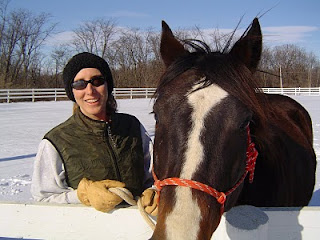
And since I manufactured an excuse for cute pet pics yesterday I certainly can't waste this excuse to post a piccy of my equine sweetie. This is from a couple years ago when we still lived where it snows. (trust me, we are loving winters that feature sunshine-filled days with highs in the upper 60s - this weekend was gorgeous)

Except in very rare occasions - so rare, mind you, that I haven't actually ever witnessed one of these hypothetical occasions - horses do not neigh or snort "in protest" to a human action like, say, shifting your weight in the saddle or other such things I read in books that occur to make a horse neigh or snort in protest.
List of horse breeds I am around on an almost daily basis:
quarter horses
paints
percherons
standardbreds
thoroughbreds
clydesdales
List of actions that have elicited neighs:
separation from herd or buddy
greeting herd or buddy
food is on the way (even this is more often a nicker)
human buddy arrives (except for some overly "chatty" horses this too is fairly rare)
List of actions that have elicited snorts:
a surprise (like, whoa-nelly I didn't notice there was a potbelly pig over there - snort, snort)
exercise (deep exhalations often sound like snorts)
Horses communicate with their bodies not their mouths. To protest, horses pin their ears, toss their heads, kick out, swish their tales, strike, pull back, buck, rear, freeze, bolt and any number of other actions but it's almost always with their bodies not their voices.
As a little illustration my horse that I have owned for 5 years has neighed at me twice, once for food and once for a greeting (though he probably knew he would soon get food so maybe it wasn't a greeting). Not once has he neighed or snorted in protest though he has tossed his head, swished his tail and bucked in protest. Of course, I try not to give him anything to protest about but it still happens from time to time and he's smart enough to let me know when I've done something wrong. But always with his body.
So please, authors, spend a little time with horses if you are going to put them in your books. Just a little time and then you'll see how efficient these beautiful creatures are. They don't waste their breath because they know just the right look is protest enough.
And since I manufactured an excuse for cute pet pics yesterday I certainly can't waste this excuse to post a piccy of my equine sweetie. This is from a couple years ago when we still lived where it snows. (trust me, we are loving winters that feature sunshine-filled days with highs in the upper 60s - this weekend was gorgeous)


Sunday, February 14, 2010
District 9 (2009)
Title: District 9
Director: Neill Blomkamp
Studio: QED International (2009)
The most disappointing thing about District 9 is that this story was a great idea that was fucked up. You watch something like this and it has such potential but then the stank rises and you know there's no option for a re-do because it was just done. Ugh!
Brief (oh so very brief) comments on what was done well:
Now it's time to buckle up because the bad, oh it was plentiful!
Note: Some of these might be considered mild spoilers so read at your own risk.
The first clue of the stink was one of the opening lines when the chosen location of the spaceship was described. "It could have been Manhattan, Washington or Chicago but it chose Johannesburg." Really??? Those are the three cities you thought of? They aren't even the biggest in the world and they're all on the same damn continent, in the same country! Plus, one of them isn't a city.
Then I'm supposed to believe that a population housed on the money of a corporation has to give individual signatures on eviction notices before they can be moved? And then the organization filmed the unlawful way they obtained said signatures? Wha???
Additionally, I could tell from the sentimental close-ups and sincere soundtrack that I was supposed to care for this population but they were most often shown fighting over crap and generally acting buffoonish. Shouldn't the viewer get a few shots of them trying to carry on with daily life? Maybe show me the conditions of their homes or what type of food they have access to? Seriously, they were living in a slum which will generally elicit the sympathy of anyone but you totally skip over this opportunity?
The anti-hero worked pretty well but he was one of the forerunners in the stupid contest that was clearly being held by several characters. While serving the eviction notices he gets sprayed in the face with an unknown substance from an alien looking object. Shortly after, he vomits, projectilely. This is not cause for alarm? You do not need to be checked out?
What the fuck keeps the spaceship in the air for two decades? If this type of technology was hanging up in the sky for all to see am I supposed to believe that it would not have been dismantled for research?
Why can't military trained personnel ever act like professionals? Why must they laugh maniacally and get a gleam in their eyes whenever they can be destructive? They are professionals for shit's sake.
The aliens have some pretty fantastic weaponry. Hot diggity this stuff can do some damage. It's tied in with their DNA, though, so humans can't use it (nifty.) One of the human slum warlords really wants to be able to use these weapons. Let me be clear on WARLORD so that you understand that he is a leader. He also trades in weaponry and has a fucking ROBOT in his house. It's an alien robot but still, he sees it working and knows how weapons work. I'm supposed to believe that this guy actually subscribes to the theory that EATING the aliens will result in his being able to use their weapons? Come on!
At one point, a group of idiots have decided it is a good idea to saw into a patient's chest without tying him down or knocking him out. This is bad enough but it gets worse. The patient is not too keen on the chest sawing (for obvious reasons) and so goes a bit apeshit and knocks a bunch of people out. This whole operation is going down in a secure facility run by a multi-billion dollar corporation and when the alarm is sounded only ONE PERSON responds. wtf???? Then the patient uses a hostage to escape this one person. Yes, you heard that right. We're in a facility where they will saw into someone's chest with no anesthesia but they will not shoot one insignificant medical attendant to retain the patient who is the key to their billion dollar project. Oh, and he's escaping a biohazard facility with alarms, lock downs and armed-to-the-teeth security personnel (well, one at the very least) but he easily slips out a side door onto the street. Again, what the fuck?
My last comment is 100% spoilerish so highlight if interested:
'Member those cool weapons I spoke of above? Well, they are scattered about willy nilly. Not sure how many there are but they pop up often enough that I'm gonna say there's a nice stash available. In fact, one of these stashes is actually in the slum under the care of our lovable but unbelievably stupid warlord. (and let's not forget the robot that is there that can also only be controlled by an alien and contains weaponry upon its person, or robotness... whatever) But what do the 1.8 million aliens who have the exclusive skill of using these weapons do? They hang about in a slum being mistreated by the organization that supposedly cares for them. It also becomes clear that they have superior physical abilities and strength. They can hop on top of shacks and throw humans really hard. So this sitch has been going on for two decades and what is it that finally get these aliens riled up? That's right, it's our very WASPy looking anti-hero, who has "gone native" due to the earlier splatting of the unidentifiable substance in his face, taking control of the robot and using its ass-kicking abilities to shoot the baddies thus inspiring the aliens to rebel against the gun-toting totally-non-professional military jizzwad. Give me a fucking break!
There's actually a lot more that could go on this list but I think you get the point. Nonsensical shit happened in almost every scene. In short, almost total disaster. And again, what a disappointment. This is a great idea for a movie. Maybe it'll get remade in a couple years and they can get it right.
If you're interested in some nice camera work and some good effects then District 9 will certainly fulfill your needs. If you'd actually like an original story or at least a decent story told well then you might want to skip this one. I have a feeling the six minute short film it's based on is probably much better since there's a lot less time to screw it up.
rating: 2 of 5 stars
Director: Neill Blomkamp
Studio: QED International (2009)
The most disappointing thing about District 9 is that this story was a great idea that was fucked up. You watch something like this and it has such potential but then the stank rises and you know there's no option for a re-do because it was just done. Ugh!
Brief (oh so very brief) comments on what was done well:
- Excellent job with an authentic anti-hero (course this was jacked by the portrayal of said anti-hero at the end)
- Decent script without too many cringe worthy lines from one dimensional characters
- Good directing with amazing cinematography
- Super rad shot of helos going towards giant - and effing awesome - spaceship
- Excellent special effects
Now it's time to buckle up because the bad, oh it was plentiful!
Note: Some of these might be considered mild spoilers so read at your own risk.
The first clue of the stink was one of the opening lines when the chosen location of the spaceship was described. "It could have been Manhattan, Washington or Chicago but it chose Johannesburg." Really??? Those are the three cities you thought of? They aren't even the biggest in the world and they're all on the same damn continent, in the same country! Plus, one of them isn't a city.
Then I'm supposed to believe that a population housed on the money of a corporation has to give individual signatures on eviction notices before they can be moved? And then the organization filmed the unlawful way they obtained said signatures? Wha???
Additionally, I could tell from the sentimental close-ups and sincere soundtrack that I was supposed to care for this population but they were most often shown fighting over crap and generally acting buffoonish. Shouldn't the viewer get a few shots of them trying to carry on with daily life? Maybe show me the conditions of their homes or what type of food they have access to? Seriously, they were living in a slum which will generally elicit the sympathy of anyone but you totally skip over this opportunity?
The anti-hero worked pretty well but he was one of the forerunners in the stupid contest that was clearly being held by several characters. While serving the eviction notices he gets sprayed in the face with an unknown substance from an alien looking object. Shortly after, he vomits, projectilely. This is not cause for alarm? You do not need to be checked out?
What the fuck keeps the spaceship in the air for two decades? If this type of technology was hanging up in the sky for all to see am I supposed to believe that it would not have been dismantled for research?
Why can't military trained personnel ever act like professionals? Why must they laugh maniacally and get a gleam in their eyes whenever they can be destructive? They are professionals for shit's sake.
The aliens have some pretty fantastic weaponry. Hot diggity this stuff can do some damage. It's tied in with their DNA, though, so humans can't use it (nifty.) One of the human slum warlords really wants to be able to use these weapons. Let me be clear on WARLORD so that you understand that he is a leader. He also trades in weaponry and has a fucking ROBOT in his house. It's an alien robot but still, he sees it working and knows how weapons work. I'm supposed to believe that this guy actually subscribes to the theory that EATING the aliens will result in his being able to use their weapons? Come on!
At one point, a group of idiots have decided it is a good idea to saw into a patient's chest without tying him down or knocking him out. This is bad enough but it gets worse. The patient is not too keen on the chest sawing (for obvious reasons) and so goes a bit apeshit and knocks a bunch of people out. This whole operation is going down in a secure facility run by a multi-billion dollar corporation and when the alarm is sounded only ONE PERSON responds. wtf???? Then the patient uses a hostage to escape this one person. Yes, you heard that right. We're in a facility where they will saw into someone's chest with no anesthesia but they will not shoot one insignificant medical attendant to retain the patient who is the key to their billion dollar project. Oh, and he's escaping a biohazard facility with alarms, lock downs and armed-to-the-teeth security personnel (well, one at the very least) but he easily slips out a side door onto the street. Again, what the fuck?
My last comment is 100% spoilerish so highlight if interested:
'Member those cool weapons I spoke of above? Well, they are scattered about willy nilly. Not sure how many there are but they pop up often enough that I'm gonna say there's a nice stash available. In fact, one of these stashes is actually in the slum under the care of our lovable but unbelievably stupid warlord. (and let's not forget the robot that is there that can also only be controlled by an alien and contains weaponry upon its person, or robotness... whatever) But what do the 1.8 million aliens who have the exclusive skill of using these weapons do? They hang about in a slum being mistreated by the organization that supposedly cares for them. It also becomes clear that they have superior physical abilities and strength. They can hop on top of shacks and throw humans really hard. So this sitch has been going on for two decades and what is it that finally get these aliens riled up? That's right, it's our very WASPy looking anti-hero, who has "gone native" due to the earlier splatting of the unidentifiable substance in his face, taking control of the robot and using its ass-kicking abilities to shoot the baddies thus inspiring the aliens to rebel against the gun-toting totally-non-professional military jizzwad. Give me a fucking break!
There's actually a lot more that could go on this list but I think you get the point. Nonsensical shit happened in almost every scene. In short, almost total disaster. And again, what a disappointment. This is a great idea for a movie. Maybe it'll get remade in a couple years and they can get it right.
If you're interested in some nice camera work and some good effects then District 9 will certainly fulfill your needs. If you'd actually like an original story or at least a decent story told well then you might want to skip this one. I have a feeling the six minute short film it's based on is probably much better since there's a lot less time to screw it up.
rating: 2 of 5 stars
Thursday, February 11, 2010
A Style Nod to FJM
Mr Musacha says... I'm breaking this one down FJM style:
The movie studio that produced the mega-blockbuster, "Avatar," had no problem with the film's alien race being blue -- but it turns out they were initially concerned about the Na'vi being too green.
Damn jealous aliens. Or are they sick? There's actually a lot of metaphorical ways people (and aliens) can be green.
According to director James Cameron, 20th Century Fox had some initial apprehension that his $2 billion-dollar-baby delivered the wrong kind of message -- the message of environmental conservation.
Oh, the aliens are environmentalists. I heard about those guys during the Super Bowl...apparently they're quite the group of fascists. No wonder the studio was nervous.
Cameron recollects the studio's warning as being: "We really like the story. It's great. But, well, is there a way to not have so much of this tree-hugging, 'Ferngully' stuff in it?"
Wow. Even studio executives, the most useless and uncreative people on the planet, recognized that Avatar was just a ripoff of a cartoon movie.
The famously exacting director wasn't going give up on the central point of the "Avatar" story.
Anyone who thinks the "central point" of Avatar wasn't the special effects is kidding themselves.
"I said, 'Not with me making it,'" Cameron said. "Because that was my purpose in making the film. I wanted to make an environmentally conscious mainstream movie."
I don't know the exact carbon footprint involved with the making of Avatar, but Cameron employed an entire crew of special effects artists to work around the clock for two years on a fleet of computers powerful enough to draw his fancy jungle movie. That doesn't even account for the impact of the filming itself. So let's just assume the carbon footprint was SIGNIFICANT.
Hey James, here's an idea for your next environmentally conscious movie...it's you handing a check for 2 billion dollars to Greenpeace, filmed on a camcorder, then not making a feature film. The environment will thank you.
"FernGully: The Last Rainforest" was a 1992 animated film -- also released by 20th Century Fox -- featuring the voice of Tim Curry as the villain who gains his power from pollution.
Was it so long ago? From the commercials on my T.V. I could have sworn FernGully came out a few months ago.
Instead of backing down, Cameron, instead, reveled in the environmental themes leading up to the climatic conclusion of "Avatar". "I think there's something amazingly satisfying when the hammerheads come out of the forest and start mowing down all the bad security enforcers. Nature gets to fight back," he said. "It's 'Death Wish' for environmentalists. When did nature ever get to fight back in a movie?"
Jaws. Birds. The Ghost and the Darkness. Pretty much any movie where animals go after humans (usually explained by territory encroachment). Hell, what about King Kong? Pretty strong message about humanity's exploitation of nature there, and Kong kicks all kinds of ass before biting it. The Ents (sp?) have their day in Lord of the Rings. Or how about Fern Fucking Gully??? Wasn't that shitty Open Season movie about people encroaching on the woods and the animals fighting back? That happened in Dr. Doolittle 2 as well. Shit, these are just off the top of my head, James.
Cameron concedes that 20th Century Fox wouldn't have been the only studio with concerns. "To be fair…any of the other studios would have said the same thing. Fox ended up being enormously supportive and wrote this huge check. But they would have been much more comfortable if I had eliminated what they called the 'tree-hugging' elements."
Maybe they just wanted a story that wasn't so contrived and corny.
James Cameron's environmental concerns can be attributed to being a parent of three young children and the fact he would like them to have a world to grow up in. "I think there's a way to live and raise your kids with a set of values that teaches them the importance of hard work, the importance of respecting other people and the importance of respecting nature. And that it's not this consumer society where you buy something and then throw it away when you get the next new thing, filling up huge landfills with plastic and electronics."
Good call. That's probably why you approved the licensing of Avatar merchandise to McDonalds so they could produce plastic replicas of vehicles and animals from your movie and distribute them to children in Happy Meals. I'm sure people will view those trinkets as treasured keepsakes, and that none of them will ever end up in a landfill. At least you're dealing with a company in McDonalds known world-wide for their outstanding contributions to the environment.
Cameron's environmentally friendly message has not, as the studio was initially concerned, negatively affected box-office receipts. "Avatar" has so far grossed over $2.2 billion worldwide – which is well over a billion ahead of the ticket sales for the closest best picture Oscar rival, "The Hurt Locker." That film (which also has an arguably controversial message in its coverage of soldiers in Iraq) was directed by his former wife, Kathryn Bigelow, and has only taken in $12.6 million in domestic box-office sales.
Take that, Kathryn Bigelow! I'm shocked - SHOCKED - that a big-budget movie crammed full of special effects and with a derivative plot is more popular than a challenging drama about soldiers who risk their lives to disarm bombs in Iraq. It's like I don't even know the American public any more.
The movie studio that produced the mega-blockbuster, "Avatar," had no problem with the film's alien race being blue -- but it turns out they were initially concerned about the Na'vi being too green.
Damn jealous aliens. Or are they sick? There's actually a lot of metaphorical ways people (and aliens) can be green.
According to director James Cameron, 20th Century Fox had some initial apprehension that his $2 billion-dollar-baby delivered the wrong kind of message -- the message of environmental conservation.
Oh, the aliens are environmentalists. I heard about those guys during the Super Bowl...apparently they're quite the group of fascists. No wonder the studio was nervous.
Cameron recollects the studio's warning as being: "We really like the story. It's great. But, well, is there a way to not have so much of this tree-hugging, 'Ferngully' stuff in it?"
Wow. Even studio executives, the most useless and uncreative people on the planet, recognized that Avatar was just a ripoff of a cartoon movie.
The famously exacting director wasn't going give up on the central point of the "Avatar" story.
Anyone who thinks the "central point" of Avatar wasn't the special effects is kidding themselves.
"I said, 'Not with me making it,'" Cameron said. "Because that was my purpose in making the film. I wanted to make an environmentally conscious mainstream movie."
I don't know the exact carbon footprint involved with the making of Avatar, but Cameron employed an entire crew of special effects artists to work around the clock for two years on a fleet of computers powerful enough to draw his fancy jungle movie. That doesn't even account for the impact of the filming itself. So let's just assume the carbon footprint was SIGNIFICANT.
Hey James, here's an idea for your next environmentally conscious movie...it's you handing a check for 2 billion dollars to Greenpeace, filmed on a camcorder, then not making a feature film. The environment will thank you.
"FernGully: The Last Rainforest" was a 1992 animated film -- also released by 20th Century Fox -- featuring the voice of Tim Curry as the villain who gains his power from pollution.
Was it so long ago? From the commercials on my T.V. I could have sworn FernGully came out a few months ago.
Instead of backing down, Cameron, instead, reveled in the environmental themes leading up to the climatic conclusion of "Avatar". "I think there's something amazingly satisfying when the hammerheads come out of the forest and start mowing down all the bad security enforcers. Nature gets to fight back," he said. "It's 'Death Wish' for environmentalists. When did nature ever get to fight back in a movie?"
Jaws. Birds. The Ghost and the Darkness. Pretty much any movie where animals go after humans (usually explained by territory encroachment). Hell, what about King Kong? Pretty strong message about humanity's exploitation of nature there, and Kong kicks all kinds of ass before biting it. The Ents (sp?) have their day in Lord of the Rings. Or how about Fern Fucking Gully??? Wasn't that shitty Open Season movie about people encroaching on the woods and the animals fighting back? That happened in Dr. Doolittle 2 as well. Shit, these are just off the top of my head, James.
Cameron concedes that 20th Century Fox wouldn't have been the only studio with concerns. "To be fair…any of the other studios would have said the same thing. Fox ended up being enormously supportive and wrote this huge check. But they would have been much more comfortable if I had eliminated what they called the 'tree-hugging' elements."
Maybe they just wanted a story that wasn't so contrived and corny.
James Cameron's environmental concerns can be attributed to being a parent of three young children and the fact he would like them to have a world to grow up in. "I think there's a way to live and raise your kids with a set of values that teaches them the importance of hard work, the importance of respecting other people and the importance of respecting nature. And that it's not this consumer society where you buy something and then throw it away when you get the next new thing, filling up huge landfills with plastic and electronics."
Good call. That's probably why you approved the licensing of Avatar merchandise to McDonalds so they could produce plastic replicas of vehicles and animals from your movie and distribute them to children in Happy Meals. I'm sure people will view those trinkets as treasured keepsakes, and that none of them will ever end up in a landfill. At least you're dealing with a company in McDonalds known world-wide for their outstanding contributions to the environment.
Cameron's environmentally friendly message has not, as the studio was initially concerned, negatively affected box-office receipts. "Avatar" has so far grossed over $2.2 billion worldwide – which is well over a billion ahead of the ticket sales for the closest best picture Oscar rival, "The Hurt Locker." That film (which also has an arguably controversial message in its coverage of soldiers in Iraq) was directed by his former wife, Kathryn Bigelow, and has only taken in $12.6 million in domestic box-office sales.
Take that, Kathryn Bigelow! I'm shocked - SHOCKED - that a big-budget movie crammed full of special effects and with a derivative plot is more popular than a challenging drama about soldiers who risk their lives to disarm bombs in Iraq. It's like I don't even know the American public any more.
Monday, February 8, 2010
Almost Like Being in Love by Steve Kluger
Title: Almost Like Being in Love
Author: Steve Kluger
Publisher: HarperCollins (2004)
Travis, a slightly OCD nerd, and Craig, a successful athlete, meet during a production of Brigadoon in high school and fall in love towards the end of their senior year. After spending the summer together they attend colleges on opposite sides of the country and eventually lose touch. Flash forward 20 years to 1998 and Travis, a slough of unsuccessful relationships behind him, wonders if the love of his life is still Craig. And, oh yeah, is Craig still thinking about him?
Almost Like Being in Love is a really sweet story. I mean a really, really sweet story. In fact, it'd be a little over-the-top saccharine if not for the fun style and Kluger's obvious sense of whimsy and humor. The story is presented via newspaper clippings, assignments, journal entries, library research requests and even trial transcripts. It makes the story a fun puzzle but don't worry it's never confusing. It's also laugh out loud funny most of the time. Like on p. 157 when Travis, a history professor, presents an extra credit question to his students regarding the best way to track down Craig. Remember, Travis is a stickler for order and correctness. Student Chuck Navarro answers:
Or on p. 251 when Travis's friend, who's writing a screenplay based on the whole fiasco, says:
This is that obvious sense of humor of Kluger's because right around this time, as a Reader, I was like, "Hey, Mr. Kluger, how are you going to get out of this without making Travis look like a jizzwad?" I had to laugh as Kluger clearly knew what I was thinking.
But then you'll also run by a section that has some real meat to it. On p. 233, in a nice Kids Say the Darnedest Things way, 11yo Noah asks (condensed):
Travis and Craig are great protags to root for and the supporting cast isn't bad either. Gordo, Travis's roommate in high school and present day, ended up being a huge surprise. When he was first introduced I had no idea he was going to become so interesting. He's also a great friend to Travis which is always good. However, the supporting characters did sometimes fall into a few cliches I could have done without. Like in Gordo's case, why does there always have to be a slutty friend? Is it just me that's missing out on a ridiculously slutty friend? If I were a character in a book would I then have a slutty friend? I fully support anyone's right to do the sweaty tango as often as they like with as many people as they like but it's just so often overdone in books.
Also, I found the characterization to be a bit flawed. Sometimes I'd be reading a journal entry and forget whose perspective it was. Character voice over-lapped quite a bit. I really liked the characters so it didn't bother me too much but I still think they should have been more distinct.
The book reminded me yet again how awesome the webbie be! Holy crap, it's so much easier to do research (read: stalk the world) in the age of the internet. I've assimilated so well into this age that I have relegated my pre-internet life to a dark corner of my brain so I don't think about it much but holy shit the world wide web is fucking awesome!
rating: 3 of 5 stars
Author: Steve Kluger
Publisher: HarperCollins (2004)
Travis, a slightly OCD nerd, and Craig, a successful athlete, meet during a production of Brigadoon in high school and fall in love towards the end of their senior year. After spending the summer together they attend colleges on opposite sides of the country and eventually lose touch. Flash forward 20 years to 1998 and Travis, a slough of unsuccessful relationships behind him, wonders if the love of his life is still Craig. And, oh yeah, is Craig still thinking about him?
Almost Like Being in Love is a really sweet story. I mean a really, really sweet story. In fact, it'd be a little over-the-top saccharine if not for the fun style and Kluger's obvious sense of whimsy and humor. The story is presented via newspaper clippings, assignments, journal entries, library research requests and even trial transcripts. It makes the story a fun puzzle but don't worry it's never confusing. It's also laugh out loud funny most of the time. Like on p. 157 when Travis, a history professor, presents an extra credit question to his students regarding the best way to track down Craig. Remember, Travis is a stickler for order and correctness. Student Chuck Navarro answers:
I vote for St. Louis because you're ready to handle it. Know how I know? Go back to multiple choice (a). "There's laws against stalking." Wrong. "There ARE laws against stalking." Welcome to the Human Fucking Race.
Or on p. 251 when Travis's friend, who's writing a screenplay based on the whole fiasco, says:
I'm running into a little snag. I thought it'd be more realistic if Craig had a boyfriend--but I think I've written myself into a corner. How do I keep Travis from giving up?
This is that obvious sense of humor of Kluger's because right around this time, as a Reader, I was like, "Hey, Mr. Kluger, how are you going to get out of this without making Travis look like a jizzwad?" I had to laugh as Kluger clearly knew what I was thinking.
But then you'll also run by a section that has some real meat to it. On p. 233, in a nice Kids Say the Darnedest Things way, 11yo Noah asks (condensed):
"They won't let you and Clayton get married, right?"
"Right."
"And a long time ago, they wouldn't let Rosa Parks sit in a bus either--right?"
"Right."
"And now everybody thinks the people who arrested her were skanks, right?"
"Right"
"So how come they don't know that in a hundred years we'll think the same things about the skanky guys who won't let you get married?"
(I love the excellent use of skank.)
(I also hope it's less than a hundred years.)
Travis and Craig are great protags to root for and the supporting cast isn't bad either. Gordo, Travis's roommate in high school and present day, ended up being a huge surprise. When he was first introduced I had no idea he was going to become so interesting. He's also a great friend to Travis which is always good. However, the supporting characters did sometimes fall into a few cliches I could have done without. Like in Gordo's case, why does there always have to be a slutty friend? Is it just me that's missing out on a ridiculously slutty friend? If I were a character in a book would I then have a slutty friend? I fully support anyone's right to do the sweaty tango as often as they like with as many people as they like but it's just so often overdone in books.
Also, I found the characterization to be a bit flawed. Sometimes I'd be reading a journal entry and forget whose perspective it was. Character voice over-lapped quite a bit. I really liked the characters so it didn't bother me too much but I still think they should have been more distinct.
The book reminded me yet again how awesome the webbie be! Holy crap, it's so much easier to do research (read: stalk the world) in the age of the internet. I've assimilated so well into this age that I have relegated my pre-internet life to a dark corner of my brain so I don't think about it much but holy shit the world wide web is fucking awesome!
rating: 3 of 5 stars
Thursday, February 4, 2010
Wednesday, February 3, 2010
Monday, February 1, 2010
Freakonomics and Agnes and the Hitman
Odd pairing, I know. As far as I can tell the list that follows comprises what these two books have in common: they were published in English, they have two authors, I read them in the same week, neither elicited a strong enough response from me to actually want to give them a proper review. So instead, just a little blurb on each.
Title: Agnes and the Hitman
Author: Jennifer Crusie and Bob Mayer
Publisher: St. Martin's Press (2007)
Holy hell I can't remember the last time I saw italics used so extensively. I think my brain actually started to fizz like pop rocks due to the italics. I eventually had to mentally edit them out as I couldn't take it anymore.
Crusie's books have always been sort of hit or miss with me. I don't know if it's all of her books or just the ones I've read but the courtships are always so fast; that never works for me in contemporary romance. What did work for me in this one was the hilarity that was Agnes's anger problem and the awesome supporting character of Carpenter.
rating: 3 of 5 stars (without italics)
2 of 5 stars (with italics)
Title: Freakonomics: A Rogue Economist Explores the Hidden Side of Everything
Author: Steven D. Levitt and Stephen J. Dubner
Publisher: William Morrow (2006)
This book is chock full of interesting information and I can see why so many people have read it. I didn't care that it didn't have a 'unifying theme' but I was often struck by how random even the individual topics were at times. Analogies were used that I thought would be explained later but were really just as random as they appeared. Seriously, through the whole thing I was like, you're not going to say any more about the pantyhose than that?
My favorite bit from the book was this (p. 89 of the paperback edition):
I was once in a friendly debate with someone and they kept saying something that I really didn't think was true. However, at that time, I didn't have evidence to back up my position. I decided it was time to finally get some evidence. I did extensive research on the topic, compiled dates and numbers, proudly organized it all and then presented my shiny new evidence. I was so thrilled with what I was able to find because some of it was even a surprise to me. I thought how great it was that we were going to have some hard facts to talk about. You can imagine my flabbergastation when this happened:
sgwordy says - Look at all my shiny evidence. Can you believe that this is what is actually going on?
someone's response - I don't care what the numbers say that isn't how it works.
I was, to say the very least, stunned - and not just because gathering that evidence required reading over some DOD budgets (ugh!) and I was a bit put out that my effort was not rewarded. I was truly stunned that someone could be so stuck on the "conventional wisdom" that s/he would not even entertain evidence to the contrary. Galbraith's words describe so succinctly what I could not understand. I think I'm going to have to look him up for some future reading.
rating: 4 of 5 stars
Title: Agnes and the Hitman
Author: Jennifer Crusie and Bob Mayer
Publisher: St. Martin's Press (2007)
Holy hell I can't remember the last time I saw italics used so extensively. I think my brain actually started to fizz like pop rocks due to the italics. I eventually had to mentally edit them out as I couldn't take it anymore.
Crusie's books have always been sort of hit or miss with me. I don't know if it's all of her books or just the ones I've read but the courtships are always so fast; that never works for me in contemporary romance. What did work for me in this one was the hilarity that was Agnes's anger problem and the awesome supporting character of Carpenter.
rating: 3 of 5 stars (without italics)
2 of 5 stars (with italics)
Title: Freakonomics: A Rogue Economist Explores the Hidden Side of Everything
Author: Steven D. Levitt and Stephen J. Dubner
Publisher: William Morrow (2006)
This book is chock full of interesting information and I can see why so many people have read it. I didn't care that it didn't have a 'unifying theme' but I was often struck by how random even the individual topics were at times. Analogies were used that I thought would be explained later but were really just as random as they appeared. Seriously, through the whole thing I was like, you're not going to say any more about the pantyhose than that?
My favorite bit from the book was this (p. 89 of the paperback edition):
It was John Kenneth Galbraith, the hyperliterate economic sage, who coined the phrase "conventional wisdom." He did not consider it a compliment. "We associate truth with convenience," he wrote, "with what most closely accords with self-interest and personal well-being or promises best to avoid awkward effort or unwelcome dislocation of life. We also find highly acceptable what contributes most to self-esteem." Economic and social behavior, Galbraith continued, "are complex, and to comprehend their character is mentally tiring. Therefore we adhere, as though to a raft, to those ideas which represent our understanding."
I was once in a friendly debate with someone and they kept saying something that I really didn't think was true. However, at that time, I didn't have evidence to back up my position. I decided it was time to finally get some evidence. I did extensive research on the topic, compiled dates and numbers, proudly organized it all and then presented my shiny new evidence. I was so thrilled with what I was able to find because some of it was even a surprise to me. I thought how great it was that we were going to have some hard facts to talk about. You can imagine my flabbergastation when this happened:
sgwordy says - Look at all my shiny evidence. Can you believe that this is what is actually going on?
someone's response - I don't care what the numbers say that isn't how it works.
I was, to say the very least, stunned - and not just because gathering that evidence required reading over some DOD budgets (ugh!) and I was a bit put out that my effort was not rewarded. I was truly stunned that someone could be so stuck on the "conventional wisdom" that s/he would not even entertain evidence to the contrary. Galbraith's words describe so succinctly what I could not understand. I think I'm going to have to look him up for some future reading.
rating: 4 of 5 stars
Friday, January 29, 2010
Invisible Library
Well this is just all kinds of fun. Click here for an article on the Invisible Library blog and how it got started. I noticed this right off:
Since I've been going through Nabokov's works recently I'm going to use this as the deciding factor for his next book to put to the top of the TBR pile.
Click here to go straight to the Invisible Library blog.
(hat tip: Schmells)
"The genesis of the library was very simple," says Stahl. "I happened to read Nabokov's The Real Life of Sebastian Knight and Graham Greene's The End of the Affair in quick succession, and was struck by the number of nonexistent novels mentioned, and at times even described in each book."
Since I've been going through Nabokov's works recently I'm going to use this as the deciding factor for his next book to put to the top of the TBR pile.
Click here to go straight to the Invisible Library blog.
(hat tip: Schmells)
Thursday, January 28, 2010
The Cake Is a Lie!
She's baaaaaaaaack! And Still Alive!
Mr M recently downloaded the Xbox LIVE arcade game Portal: Still Alive. Portal has been featured here at sgwordy before and for good reason. This game is more awesome than Captain Awesome (though it can't compete with his abs)! The reasons are too numerous to list here (maybe our resident gamer can link to his thoughts on Portal in the comments so you all can learn those reasons) so I'll just focus on GlaDOS. (And yes, it is the GlaDOS of quotable fame at the top of this blog header.)
GlaDOS' part in this game is to screw up things for the test subject as she tries to escape. Part of GlaDOS' strategy is to talk lots of shit in an attempt to demoralize the test subject. She's damn funny and just one of the details that sets Portal above and beyond the typical video game. For instance, take this scene featuring the demise of the Weighted Companion Cube (btw, I luuuuuuuuurve the Weighted Companion Cube).
*sniff*
But joy! I came across this video saving the Weighted Companion Cube!
Mr M recently downloaded the Xbox LIVE arcade game Portal: Still Alive. Portal has been featured here at sgwordy before and for good reason. This game is more awesome than Captain Awesome (though it can't compete with his abs)! The reasons are too numerous to list here (maybe our resident gamer can link to his thoughts on Portal in the comments so you all can learn those reasons) so I'll just focus on GlaDOS. (And yes, it is the GlaDOS of quotable fame at the top of this blog header.)
GlaDOS' part in this game is to screw up things for the test subject as she tries to escape. Part of GlaDOS' strategy is to talk lots of shit in an attempt to demoralize the test subject. She's damn funny and just one of the details that sets Portal above and beyond the typical video game. For instance, take this scene featuring the demise of the Weighted Companion Cube (btw, I luuuuuuuuurve the Weighted Companion Cube).
*sniff*
But joy! I came across this video saving the Weighted Companion Cube!
Tuesday, January 19, 2010
In Addition to Basic Fairness
Same-sex marriage appears to prevent divorce! Click here for a simple statistical rundown on divorce rates per state as compared to the state's same-sex marriage policy. A short quote from the article:
Of all the weak-ass arguments against same-sex marriage, preserving the "sanctity" of heterosexual marriage has always been the worst fucking one (how people I don't know getting married is supposed to affect my own marriage is a mystery that continues to confound). And yay! Now there appears to be data that show just how stupid that argument is! It's important to note though, that, in the end, it really doesn't matter: whatever data are uncovered and however they are presented current laws are unfair and that's the real problem.
(hat tip: Mr M)
As is somewhat visually apparent, those states which have tended to take more liberal policies toward gay marriage have tended also to have larger declines in their divorce rates.
Of all the weak-ass arguments against same-sex marriage, preserving the "sanctity" of heterosexual marriage has always been the worst fucking one (how people I don't know getting married is supposed to affect my own marriage is a mystery that continues to confound). And yay! Now there appears to be data that show just how stupid that argument is! It's important to note though, that, in the end, it really doesn't matter: whatever data are uncovered and however they are presented current laws are unfair and that's the real problem.
(hat tip: Mr M)
Mary by Vladimir Nabokov
Title: Mary
Author: Vladimir Nabokov (translated from the Russian by Michael Glenny)
Publisher: McGraw-Hill International, Inc (1970)
Mary was the first novel written by Nabokov (so the cover tells me) and originally published in 1926 (so the introduction tells me). This is the second of Nabokov's books that I have read and it won't be the last. I didn't like this title (or the other for that matter) as much as I wanted to but the writing keeps me turning pages. The characters have only been just engaging enough to keep me interested and what I'm really waiting for is a plot I can get excited about. Hmm, a plot... why don't I get to that.
Mary is set in Berlin at a lodging house that caters to Russian expatriates. We get to know all of the lodgers but the story mainly centers around Ganin. Ganin is in his mid-20s, not currently working, and dissatisfied with his relationship with his girlfriend. He has tried to leave her several times but is apparently incapable due to his lack of initiative - or maybe follow-through, it was hard for me to decide which. A surprise revelation by one of his housemates triggers his memories of a childhood sweetheart eventually leading to an upheaval of his inertia-controlled life.
One can probably gather from what I said above that it is Nabokov's writing I find so appealing. He has a very distinct style that I can't quite find the words to describe. Instead I will describe how I feel when reading. Often times there's a definite rhythm that I find myself pulled into, then a smirk finds it's way to my face and all of a sudden I find myself laughing out loud at a situation that would not normally make me laugh. So I stop and try to figure out why I'm laughing. Am I laughing at the character, the words, a private joke, laughing with the character? Honestly I can never really decide and I find that fascinating.
One beef I have is that sometimes a huge, jizztastic wrench is thrown into the whole business by a complete loss of rhythm in the writing. And do believe me, I mean a total loss! There were several times where I experienced a serious mental lurch that completely tossed me right out of the story. I found these to be mostly when the POV or situation was changed. Rather than a smooth transition taking the reader to the next locale, it's about three paragraphs of confusion until you figure out just what the heck is now going on. I'd rather demonstrate with a quote but it'd be almost page-length so instead I'll try to describe one of these bizarre "transitions."
We meet Klara, a lodger and friend of Ganin's girlfriend, for the first time at the top of a paragraph that immediately follows a section about Ganin and his girlfriend in the girlfriend's room. Klara is not in this room, or indeed even in the building, but we are suddenly in her head as she thinks about the girlfriend recounting her dates with Ganin. This moves immediately into her crush on Ganin which would all be very well and good but then we move on to the lunch seating assignments in the lodging house and the landlady's tendency to be quiet during lunch and simply ensure that the cook brings the correct dishes to table. Next paragraph Ganin is entering the dining room at lunch, on a different day, mumbling something to his fellow lodgers and where the heck Klara is at this point is anyone's guess. It made my brain fizz a bit. During these oddball transitions it's much like all the walls in Berlin have a stream-of-consciousness output that Nabokov tuned in for and then used periodically in the book.
I'm hoping that the aforementioned lurches are due to this being a first novel and that subsequent books will be a bit more polished. As I said, the writing is so intriguing to me that I'll definitely read more of his books even if this one did not blow me away story-wise. I even think the characters can be improved with a bit more polish. Nabokov does an excellent job of fleshing them out but just when I felt I was really getting under their skin suddenly I was going through one of those stilted transitions and so I had to stop thinking about the characters and try to sort out where I was now located in the story. I'm hoping this aspect of his writing is limited to this book so that I can look forward to his entire backlist for my future reading.
rating: 3 of 5 stars
Author: Vladimir Nabokov (translated from the Russian by Michael Glenny)
Publisher: McGraw-Hill International, Inc (1970)
Mary was the first novel written by Nabokov (so the cover tells me) and originally published in 1926 (so the introduction tells me). This is the second of Nabokov's books that I have read and it won't be the last. I didn't like this title (or the other for that matter) as much as I wanted to but the writing keeps me turning pages. The characters have only been just engaging enough to keep me interested and what I'm really waiting for is a plot I can get excited about. Hmm, a plot... why don't I get to that.
Mary is set in Berlin at a lodging house that caters to Russian expatriates. We get to know all of the lodgers but the story mainly centers around Ganin. Ganin is in his mid-20s, not currently working, and dissatisfied with his relationship with his girlfriend. He has tried to leave her several times but is apparently incapable due to his lack of initiative - or maybe follow-through, it was hard for me to decide which. A surprise revelation by one of his housemates triggers his memories of a childhood sweetheart eventually leading to an upheaval of his inertia-controlled life.
One can probably gather from what I said above that it is Nabokov's writing I find so appealing. He has a very distinct style that I can't quite find the words to describe. Instead I will describe how I feel when reading. Often times there's a definite rhythm that I find myself pulled into, then a smirk finds it's way to my face and all of a sudden I find myself laughing out loud at a situation that would not normally make me laugh. So I stop and try to figure out why I'm laughing. Am I laughing at the character, the words, a private joke, laughing with the character? Honestly I can never really decide and I find that fascinating.
One beef I have is that sometimes a huge, jizztastic wrench is thrown into the whole business by a complete loss of rhythm in the writing. And do believe me, I mean a total loss! There were several times where I experienced a serious mental lurch that completely tossed me right out of the story. I found these to be mostly when the POV or situation was changed. Rather than a smooth transition taking the reader to the next locale, it's about three paragraphs of confusion until you figure out just what the heck is now going on. I'd rather demonstrate with a quote but it'd be almost page-length so instead I'll try to describe one of these bizarre "transitions."
We meet Klara, a lodger and friend of Ganin's girlfriend, for the first time at the top of a paragraph that immediately follows a section about Ganin and his girlfriend in the girlfriend's room. Klara is not in this room, or indeed even in the building, but we are suddenly in her head as she thinks about the girlfriend recounting her dates with Ganin. This moves immediately into her crush on Ganin which would all be very well and good but then we move on to the lunch seating assignments in the lodging house and the landlady's tendency to be quiet during lunch and simply ensure that the cook brings the correct dishes to table. Next paragraph Ganin is entering the dining room at lunch, on a different day, mumbling something to his fellow lodgers and where the heck Klara is at this point is anyone's guess. It made my brain fizz a bit. During these oddball transitions it's much like all the walls in Berlin have a stream-of-consciousness output that Nabokov tuned in for and then used periodically in the book.
I'm hoping that the aforementioned lurches are due to this being a first novel and that subsequent books will be a bit more polished. As I said, the writing is so intriguing to me that I'll definitely read more of his books even if this one did not blow me away story-wise. I even think the characters can be improved with a bit more polish. Nabokov does an excellent job of fleshing them out but just when I felt I was really getting under their skin suddenly I was going through one of those stilted transitions and so I had to stop thinking about the characters and try to sort out where I was now located in the story. I'm hoping this aspect of his writing is limited to this book so that I can look forward to his entire backlist for my future reading.
rating: 3 of 5 stars
Saturday, January 16, 2010
GMOs: To Eat or Not To Eat
Tip of the hat to Schmells for sending me this article describing "new" data that indicate GMOs (genetically modified organisms) might be bad for your health. Here's a link also to the 2009 International Journal of Biological Sciences paper (pdf format) upon which the news article is based. Schmells asked for my scientific opinion on the article's validity and, for what it's worth, sgwordy
(whose background is not in this topic) says...
So the first thing I'll say because I think it's the most important, pertinent, and relevant is that the last paragraph (unfortunately last as most people don't read to the bottom of an article) is the thing we need to be thinking about the most:
Second thing: I don't think the news article made clear that the researchers in the IJBS journal only RE-EVALUATED previous data. The opening of the article is pretty much straight-up bullshit:
So what does this mean? It means that the conclusions of both parties (Monsanto and the 2009 researchers in the journal) are pretty much useless. Monsanto could be right that there are no problems or the new researchers could be right (which they do admit in the 2009 journal article). The salient point being made by the 2009 journal article is that these data are shit and properly designed experiments need to be conducted. As in, they would like the three strains of maize to be taken off the market until proper experiments can be done.
(whose background is not in this topic) says...
So the first thing I'll say because I think it's the most important, pertinent, and relevant is that the last paragraph (unfortunately last as most people don't read to the bottom of an article) is the thing we need to be thinking about the most:
"...ecological effects are also in play. Ninety-nine percent of GMO crops either tolerate or produce insecticide. This may be the reason we see bee colony collapse disorder and massive butterfly deaths. If GMOs are wiping out Earth's pollinators, they are far more disastrous than the threat they pose to humans and other mammals."This, to me, is way scarier than any implications for human health. I'm personally not that worried about the health effects of GMOs but I'm for damn sure worried about the collapse of ecosystems as I'm pretty sure that'd be pretty fucking bad for my health.
Second thing: I don't think the news article made clear that the researchers in the IJBS journal only RE-EVALUATED previous data. The opening of the article is pretty much straight-up bullshit:
"In what is being described as the first ever and most comprehensive study of the effects of genetically modified foods on mammalian health, researchers have linked organ damage with consumption of Monsanto’s GM maize."Maybe it's being described that way but I would imagine only by someone that did not actually read the journal article. The 2009 article does NOT include raw data collected by the researchers. And the experimental design for the raw data under re-evaluation is terrible! I mean, awful! That shit would not fly if it was to be published in a high-impact, peer-reviewed science journal. (I'm not entirely surprised by this since I gather a lot of money can make up for bad data when one is trying to bring something new to the market, call me jaded but that's my opinion.)
So what does this mean? It means that the conclusions of both parties (Monsanto and the 2009 researchers in the journal) are pretty much useless. Monsanto could be right that there are no problems or the new researchers could be right (which they do admit in the 2009 journal article). The salient point being made by the 2009 journal article is that these data are shit and properly designed experiments need to be conducted. As in, they would like the three strains of maize to be taken off the market until proper experiments can be done.
Thursday, January 14, 2010
Lessons in French by Laura Kinsale
I've said before that there's no such thing as a bad Laura Kinsale book and with Lessons in French the streak continues! I got my hot little hands on this book Monday and couldn't put it down. Ah well, getting enough sleep is overrated... especially when the alternative is a delightful cover-to-cover read of the latest Kinsale.
It's pretty bold of me to attempt a review after only one reading (a Kinsale can rarely be fully appreciated without at least two readings) but I'm gonna give it a go.
ETA: Ah, the hubris! You really can't do one of these after just one reading and now that I've finally finished my second read-through I'm back to make some changes. Actually, additions as it feels like cheating to change what I originally said but I think my interpretation was off. It's part of the spoiler stuff though so I'm adding it at the end of the post under cover, scroll down and highlight if interested.
Title: Lessons in French
Author: Laura Kinsale
Publisher: Sourcebooks Casablanca (2010)
Callie is a shy and awkward heiress more comfortable with cattle than with people. She's been engaged three times and each time her fiance has backed out. She's accepted her future as a Singleton and is happy enough in that role as long as she has a place to keep her animals. Trev, her childhood sweetheart (and partner in mischievous deeds), has returned to England after a nine year absence to care for his ailing mother. Callie has kept close ties with Trev's mother and continues to help upon his return. When the pair find themselves partners in yet another scheme (involving a wayward bull, local law enforcement and the county fair) their feelings for each other are rekindled. But Trev has secrets he must keep and neither of them are who they were nine years ago so they are each determined that this will be one final escapade together before they part again.
It's pretty bold of me to attempt a review after only one reading (a Kinsale can rarely be fully appreciated without at least two readings) but I'm gonna give it a go.
ETA: Ah, the hubris! You really can't do one of these after just one reading and now that I've finally finished my second read-through I'm back to make some changes. Actually, additions as it feels like cheating to change what I originally said but I think my interpretation was off. It's part of the spoiler stuff though so I'm adding it at the end of the post under cover, scroll down and highlight if interested.
Title: Lessons in French
Author: Laura Kinsale
Publisher: Sourcebooks Casablanca (2010)
Callie is a shy and awkward heiress more comfortable with cattle than with people. She's been engaged three times and each time her fiance has backed out. She's accepted her future as a Singleton and is happy enough in that role as long as she has a place to keep her animals. Trev, her childhood sweetheart (and partner in mischievous deeds), has returned to England after a nine year absence to care for his ailing mother. Callie has kept close ties with Trev's mother and continues to help upon his return. When the pair find themselves partners in yet another scheme (involving a wayward bull, local law enforcement and the county fair) their feelings for each other are rekindled. But Trev has secrets he must keep and neither of them are who they were nine years ago so they are each determined that this will be one final escapade together before they part again.
Tuesday, January 12, 2010
The Club Dumas by Arturo Perez-Reverte
Title: The Club Dumas
Author: Arturo Perez-Reverte (translated from the Spanish by Sonia Soto)
Publisher: Vintage (1998)
I think The Club Dumas was supposed to be a tongue-in-cheek tribute to the popular serial form used by Alexandre Dumas. As a Dumas fan, I was pretty excited to read this. Admittedly, it’s been a few years since I read The Three Musketeers, which is the Dumas book this title references most often, but I’m pretty sure this book falls quite short of the goal. The serial was originally intended for popular consumption of light entertainment with an exciting – and possibly contrived – event occurring at the end of each portion of the serial. Characters were often larger than life, twists were almost expected, and heroes were easy to identify. The Club Dumas was extremely amusing but I don’t think the author was hoping the reader would be laughing at the book rather than with it. The only reason I finished this book was because I couldn’t believe it could get any shittier. Yet, it continued to do so and thus became a source of light entertainment. Since this author clearly did not work very hard on his book,* I am also going to take the lazy route with a bullet-point style rundown.
Author: Arturo Perez-Reverte (translated from the Spanish by Sonia Soto)
Publisher: Vintage (1998)
I think The Club Dumas was supposed to be a tongue-in-cheek tribute to the popular serial form used by Alexandre Dumas. As a Dumas fan, I was pretty excited to read this. Admittedly, it’s been a few years since I read The Three Musketeers, which is the Dumas book this title references most often, but I’m pretty sure this book falls quite short of the goal. The serial was originally intended for popular consumption of light entertainment with an exciting – and possibly contrived – event occurring at the end of each portion of the serial. Characters were often larger than life, twists were almost expected, and heroes were easy to identify. The Club Dumas was extremely amusing but I don’t think the author was hoping the reader would be laughing at the book rather than with it. The only reason I finished this book was because I couldn’t believe it could get any shittier. Yet, it continued to do so and thus became a source of light entertainment. Since this author clearly did not work very hard on his book,* I am also going to take the lazy route with a bullet-point style rundown.
Friday, January 8, 2010
I miss FJM
And so to sooth my achey breaky FJM-missing heart I'll just trundle over here to read my favorite FJM post again!
Enjoy!
Enjoy!
Friday, January 1, 2010
Prodigal Summer by Barbara Kingsolver
I thought I might try to be a little more consistent in my layouts when I do reviews (excepting of course when I'm doing mass reviews of awesomeness:) for a little more structure in those posts. To that end, please enjoy this review with the new format.
Title: Prodigal Summer
Author: Barbara Kingsolver
Publisher: HarperCollins (2000)
Prodigal Summer is set in Zebulon County in southern Appalachia and tells three stories as they occur over one summer. Each story unfolds as the season progresses, the protagonists connected by the relentless demands of nature and the farming community in which they live.
A bountiful summer serves as the backdrop for the characters' lives whose stories are woven seamlessly with a wealth of natural science. The language is rich and evocative. Kingsolver is also able to introduce people in a way that immediately engages one's curiosity. She beautifully parallels the blossoming of the natural world in the slow unfolding of a character's personality and desires.
Getting to know the women in this novel was a treat. That's too tame, actually. Getting to know them was like a fresh, delicious chocolate croissant that flakes perfectly on your tongue and leaves traces of butter to be licked up on your fingers. I especially loved Deanna in contrast with Lusa. Deanna has a pretty good idea of who she is and what she wants but then has an unexpected encounter. Lusa is learning how to reconcile what she thought she wanted, and who she thought the people around her were, with the reality of her new situation. It is fitting to the theme of nature's beauty and bounty that we meet these women with partners and see how their lives are changed because of them.
The perfect descriptor for this novel is sensual. There is such a powerful sense of the raw magnetism of nature, and its relentless drive to reproduce and survive, that the reader is caught up in an almost erotic sensation of relentless tension. But at the same time that the novel elicits a visceral response it is candidly scientific. The beauty of nature's cycles are equal parts worshiped and dissected.
While I definitely give this book a sound recommendation it does have a few flaws that some readers might find more annoying than I did. It only takes a couple chapters to figure out how everything will end. I am not sure if that was deliberate or not but I found the end to be pretty obvious. Of course, it can be a comfort to know exactly where a story is going (and in another parallel to nature, the outcome of any life is pretty obvious). Also, the science works well with the story but there is a preachy sort of tone at times. I think too, depending on one's background, a lot of the science will not be new so the long preachy sections might become tedious.
rating: 4 of 5 stars
Additional comments:
I loved reading the farming arguments between Nannie and Garnet. I particularly liked Nannie's argument that "modern" farming [in this case, natural pest control, fertilization, etc] is really just "original" or "old-fashioned" farming. It's a lovely reminder that new and synthetic are not always superior to simple solutions in concert with nature. Now, I'm no Luddite (obviously:) and am thrilled with technology and innovation but not at the expense of longevity and sustainability. Technology and innovation are useless without vision and careful application.
Title: Prodigal Summer
Author: Barbara Kingsolver
Publisher: HarperCollins (2000)
Prodigal Summer is set in Zebulon County in southern Appalachia and tells three stories as they occur over one summer. Each story unfolds as the season progresses, the protagonists connected by the relentless demands of nature and the farming community in which they live.
A bountiful summer serves as the backdrop for the characters' lives whose stories are woven seamlessly with a wealth of natural science. The language is rich and evocative. Kingsolver is also able to introduce people in a way that immediately engages one's curiosity. She beautifully parallels the blossoming of the natural world in the slow unfolding of a character's personality and desires.
Getting to know the women in this novel was a treat. That's too tame, actually. Getting to know them was like a fresh, delicious chocolate croissant that flakes perfectly on your tongue and leaves traces of butter to be licked up on your fingers. I especially loved Deanna in contrast with Lusa. Deanna has a pretty good idea of who she is and what she wants but then has an unexpected encounter. Lusa is learning how to reconcile what she thought she wanted, and who she thought the people around her were, with the reality of her new situation. It is fitting to the theme of nature's beauty and bounty that we meet these women with partners and see how their lives are changed because of them.
The perfect descriptor for this novel is sensual. There is such a powerful sense of the raw magnetism of nature, and its relentless drive to reproduce and survive, that the reader is caught up in an almost erotic sensation of relentless tension. But at the same time that the novel elicits a visceral response it is candidly scientific. The beauty of nature's cycles are equal parts worshiped and dissected.
While I definitely give this book a sound recommendation it does have a few flaws that some readers might find more annoying than I did. It only takes a couple chapters to figure out how everything will end. I am not sure if that was deliberate or not but I found the end to be pretty obvious. Of course, it can be a comfort to know exactly where a story is going (and in another parallel to nature, the outcome of any life is pretty obvious). Also, the science works well with the story but there is a preachy sort of tone at times. I think too, depending on one's background, a lot of the science will not be new so the long preachy sections might become tedious.
rating: 4 of 5 stars
Additional comments:
I loved reading the farming arguments between Nannie and Garnet. I particularly liked Nannie's argument that "modern" farming [in this case, natural pest control, fertilization, etc] is really just "original" or "old-fashioned" farming. It's a lovely reminder that new and synthetic are not always superior to simple solutions in concert with nature. Now, I'm no Luddite (obviously:) and am thrilled with technology and innovation but not at the expense of longevity and sustainability. Technology and innovation are useless without vision and careful application.
Subscribe to:
Posts (Atom)