Showing posts with label movies. Show all posts

Friday, July 31, 2026

Crime 101 by Don Winslow

 Broken by Don Winslow (9780062988898)


Title: Broken
Author: Don Winslow 
Publisher: HarperCollins (2020), short story collection 
 
 
We last dusted off the joint post shelves just a quick 4 years ago, and the credit once again goes to Michael for his excellent suggestion. 

For those that are new to what was once a monthly series, this is when Michael reviews a film adaptation from a book which gets a review here.


So I guess this is technically not a book review as I'll only be reviewing the short story which has recently been adapted, however, this is a fun callback to our very first joint post which was also a short story. I haven't read Don Winslow in ages so I took a quick trip over to his website to browse titles and see how out of date I am... which is pretty well out of date these days. This is the first short story of his that I have read, but my LibraryThing records tell me I've previously read four of his novels (Satori, The Gentleman's Hour, The Dawn Patrol, and The Power of the Dog) the most recent of which was published in 2011. (Side note: I really thought I had read The Cartel but apparently I just own it but never actually read it??) 

Crime 101 is a fun, breezy romp that put me more in mind of Dawn Patrol/Gentleman's Hour than, say, The Power of the Dog. I think there's a read of this story that is not breezy or rompy but the snappy style holds you at arm's length from the characters, and even a little bit the stakes, so the seriousness of any given situation never hits quite as hard as it could. I assume that's on purpose, who wants to get gut punched by a jewel thief?

That's what we're dealing with here. Davis, a jewel thief, has the chance at one last job to get his goal bank balance (classic! I love it!) and San Diego cop Lou is convinced a string of robberies on the 101 is all one guy but no one else subscribes to his theory (another classic! I still love it!). The Pacific Coast Highway is another character in this story so I hope you like imagining the wind in your hair (though now I think about it, I'm not sure Davis ever did drive a convertible).

Davis prides himself on his ethical thieving, he's never hurt anyone and he'll even return your phone so you're not inconvenienced by losing all your family photos. Lou is going through a divorce (I'm not going to talk about the wife character, let's leave it at that I found her beneath Winslow's skill) and enjoying his temporary beach rental while pursuing his thief theory at work. They both have Crime 101 rules and I enjoyed the recurring motif, especially how it would overlap between their opposing characters. I would have liked a bit more individuality in their POV styles as it was easy to lose track of whose perspective you were in. Though I could be convinced that was also on purpose due to story structure choices, even if it's not my preference.

Because this is a short story, it's hard to get too far into describing stuff before you're in spoilers territory. I'm going to keep it vague but do skip this paragraph if you're even mild-spoilers averse. I really liked the Complicating Factor (though I did wonder if he'd still get work after making that choice) even if our ultimate villain did end up being a bit over the top. That was another aspect that made this more rompy than serious to me. A bombastic villain in this dynamic is hard to accept as a real threat. It was great to see the overlapping-opposites motif physically inhabit the story's conclusion. I wasn't all that surprised by any of the character decisions but I still found that satisfying.

There are six short stories in total in this collection and if the others are similar to Crime 101 I'd say it's a good one to get from the library, not sure I'd give it the "buy" recommendation. It was a good time but not as absorbing as other Winslow work I have read. 
 
 
Now about that movie... Don't forget to check out Michael's post.


rating: 3 of 5 stars


Click here for an index of the joint post series

Saturday, April 30, 2022

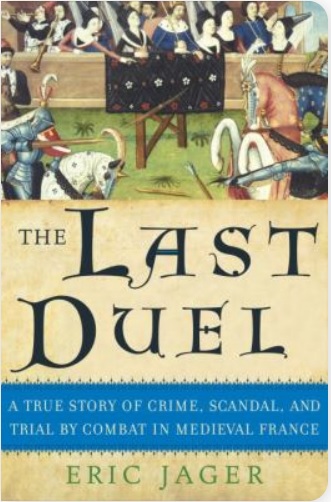
The Last Duel by Eric Jager

Title: The Last Duel: A True Story of Crime, Scandal, and Trial by Combat in Medieval France
Author: Eric Jager
Publisher: Broadway Books (2004) 

I was delighted when Michael sent an email my way asking if I'd be interested in a revisit to the joint post series for a book that has recently been adapted.

For those that are new to what was once a monthly series, this is when Michael reviews a film adapted from a book which gets a review here.


Click here for Michael's film review of The Last Duel 
at It Rains... You Get Wet


 The Last Duel, while technically a misnomer, is perfectly summarized by its subtitle. If you decide to pick this one up, you will indeed learn the true story of France's last trial by combat. The combatants were Jean de Carrouges, an unlikeable, litigious knight of good family, and Jacques Le Gris, a newly influential squire and former friend of the above. Le Gris was also a very close friend to the overlord of both men. The trial comes about because Marguerite de Carrouges accused Le Gris of rape [note: the assault and thus the testimony is graphic]. He is acquited of the crime by the above-mentioned overlord and thus Jean de Carrouges, Marguerite's husband, appeals to the king to seek justice via trial by combat. And so began what was a surprisingly (to me) bureaucratic chain of events. Trial by combat was an old and, by this time, unusual legal proceeding which had very strict rules governing it. Additionally, under fuedal law, Marguerite herself had no legal standing in this case without her husband's support and so rather than being the plaintiff, she was the chief witness. This was not a position without danger, if her husband lost the combat she would also be seen to have been false in her testimony and so would be put to death.
 
Eric Jager does an excellent job of placing the reader inside medieval France. The interwoven threads of contemporary political, cultural, social, and geographical elements are well described and make it easy to understand the relationships, political connections, and what is truly at stake. That being the case, it was not only jarring but quite sobering to read a statement that could come from any number of sources published this year.
 
So if in theory rape was a serious crime for which the law provided heavy penalties, in practice it often went unpunished, unprosecuted, and even unreported.
 
It's a credit to the writing that we can easily slip into these lives and understand their experiences and motivations. It's disquieting to feel those experiences can resonate so fully with us today.
 
In addition to firmly establishing the local political framework, Jager takes special care to describe civic infrastructure. Pardon the dry term but it does seem the best way to encapsulate how clearly he helps the reader to understand the types of roads that were being traveled, the layout of the cities, and the buildings wherein events took place. It was often in these thorough descriptions that I would find myself most firmly in "the past is a foreign country" territory. For instance, the trial took place at a monastery because Saint-Martin-des-Champ maintained a battlefield! It also contained a tribunal and a prison since it was the local criminal court. I will never think of a monastery in quite the same way again. And while we're here, let me not forget to mention that animals(!!) were also tried and condemned at Saint-Martin's.
 
I found too that Jager's committment to bringing medieval France to the modern reader hid entire books in throwaway sentences.
 
The altar was maintained by a tax on lawyers and alms paid by the accomplices in the murder of Evain Dol, a judge of the Parlement slain by his wife's lover in 1369.
 
Um, excuse me? You hit me with that and then just immediately carry on to the next paragraph?
 
One last little detail that really caught my attention was the fact that the trial had to be watched in total silence. The layout of the field of combat is detailed in the relevant chapter and, also, all the ways in which fairness was ensured. Most of this was in the design of the grounds and fencing but another rule was silence. Nothing was to distract either combatant. I truly cannot imagine watching two people fight first on horseback and then on foot, to the death, in total silence but for the sounds of the combat itself.

All in all I found this a rich, accessible text that wonderfully brought forth the humanity of those at the center of what were very violent and traumatic events. It can be hard to read violent testimony but I think Eric Jager takes care to present this accounting, as best he can, from the perspectives of those that left it.

 
Now about that movie... Don't forget to check out Michael's post. 


rating: 4 of 5 stars


Want a little behind the scenes on this book and the movie? Listen to an interview with the author here.
Want to hear a couple of historians chat about the movie? Click here (same podcast as above, different episode).
Want a little trial by combat in your fiction? Don't miss this must read! It's great in audio, as well.


Click here for an index of the joint post series

.

Monday, May 29, 2017

King Rat by James Clavell

Title: King Rat
Author: James Clavell
Publisher: Nelson Doubleday, Inc. (1962) 

I was delighted when Michael sent an email my way asking if I'd be interested in a reprise of the joint post series for a book that harkens back to a past pick of ours. I think he picked an evocative novel to revisit as we remember the sacrifices of American soldiers who have died in service to their country.

For those that are new to what was once a monthly series, this is when Michael reviews a film adapted from a book which gets a review here.


Click here for Michael's film review of King Rat 
at It Rains... You Get Wet


King Rat is set in 1945 in the WWII Japanese POW camp of Changi.The King is the operator around whom this novel revolves. He is variously seen as a thief, liar, oppressor, caretaker, and friend. Despite being in a POW camp I don't think anyone ever sees him as a victim, he certainly doesn't. Nor would he think of himself as any of the adjectives I used above.

Peter Marlowe meets the King by chance and they strike up an unlikely friendship. Unlikely not just as regards personality or class, but unlikely in that Marlowe might be the only person to know the King and still think he can have friends. The King is clearly portrayed as having come from a lower class background (though he is American, not British so his views on this would be different than Marlowe's) and his entire world is centered on camp business opportunities. Marlowe is descended from several generations of highly regarded British soldiers.

"Well, I couldn't go into business. Marlowes aren't tradesmen..."

While the King absolutely does not understand non-transactional interactions, Marlowe is bound to a personal honor code that he brings to any friendship. It is against this relationship that we see the last months of the Changi POW camp before liberation.

I wouldn't say I'm an extensive reader of WWII POW camp books but what strikes me every time I encounter one is the absurd normal that evolves for the prisoners. Much of it is easy to see as microcosms of a prisoner's home culture: Factions and alliances form, secret economies are maintained, debts and favors are scrupulously guarded. As a reader, it's easy to fall into these familiar rhythms and, despite it being the daily norm for the prisoners, be genuinely shocked when they don't have food or clothes or medicine. It's the familiar routines of life overlaid on a horrific existence that can take chapters to assimilate. (However, on the one hand, I don't want to assimilate it. I don't want to forget the horror of war simply because people are resilient enough to survive it.)

James Clavell himself was from a British military family and was imprisoned in Changi. This story and its characters are supposed to be fiction but it's hard not try overlay Clavell onto Marlowe and he was inspired by an actual American prisoner for the King's character. Regardless of how autobiographical the novel is, it's undeniable that his experience in the prison camp brings this book to life in a way that is at once searing and disturbing. Even in its touching or lighter moments one can't escape the underlying tension and fear carried by everyone in the camp. It's a gift to readers that those who had these experiences are able (and willing!) to so eloquently share them.

**Note: the rest of this review is spoiler-ish

The King and his entourage (for lack of a better word) - and his enemies - play several cat and mouse games in attempts to maintain power, either through control of resources or control of behavior. This includes the guards (the officer-prisoners) setting up various spying plans to the King's rat breeding program (yeah, that's real!). But what has lingered in my mind far past reading the last page is how in the midst of, again, this horrific experience some people were able to be themselves for the first time.

The King was a fairly obvious one to me. It was pretty clear that he was not going to be happy when the prison camp was liberated. I know how bizarre that sounds but it was certainly where his character was going. Clavell brilliantly reveals this in the juxtaposition of Marlowe and the King's response to the American soldiers who come to extract the prisoners.

The sea welcomed her and made her sleep easy, and then, in the course of time, devoured the clothes and body and the time of her.

It's not heavily explored but often hinted at that several of the prisoners find intimacy with each other who may not necessarily be gay. Also, though, I speculate that many soldiers who were gay but unable to be open about it could explore it here. I'll make no comment on whether that was a positive or a negative considering the prison camp backdrop but Clavell makes a very compelling case that one of the soldiers was transgender and might never have been able to fully accept that outside of the prison camp. This is not exactly a happy book with happy endings but I found it especially heartbreaking that Betty didn't survive liberation.


And that is something that will be on my mind today. So many do not survive. Let's honor them by getting it right next time.


Now about that movie... Don't forget to check out Michael's post. 


rating: 4 of 5 stars


Click here for an index of the joint post series

Friday, January 13, 2017

Hmmm

Andrew rattles off information about the music playing in the pizza to his girlfriend, Nicole (Melissa Benoist). Sebastian, of course, plays for Mia and teaches her to appreciate jazz. Music, then, effectively serves as both an emotional conduit and a subtle affirmation of power: where Fletcher uses his status as Andrew’s teacher as a cudgel to assert his dominance, Guy and Sebastian — and, indeed, Andrew — maintain their status as the more worldly, dominant partner in a subtler way, through the assertion of their artistic skill and cultural knowledge. With the exception of Mia, the women on the receiving end of this treatment are directionless and therefore ideal counterparts: Madeline’s field in graduate school is never specified, Nicole doesn’t even know her major, and all we know about Elena is that she is so incompetent that she has to have a man show her how to boil water. (That is the stuff of fantasy.)


Full article here. Warning: spoilers for all the films in the article.

Saturday, December 31, 2016

2016 Favorites

Favorite fiction: Shahnameh by Abolqasem Ferdowsi (Dick Davis translation)
An unusual pick as it was a year long read but a very worthwhile endeavor

Favorite non-fiction: Margaret Mahy: a writer's life by Tessa Tuder

Favorite mystery/thriller: N/A

Favorite historical fiction: Mr Allbones' Ferrets by Fiona Farrell

Favorite fantasy: The Obelisk Gate by N. K. Jemisin

Favorite Sci-fi: Planetfall by Emma Newman
The end left me a bit unsatisfied but this one otherwise really kept me turning pages

Favorite Romance: Mr Allbones' Ferrets by Fiona Farrell

Favorite Short Stories: Best of Women's Short Stories, Vol 3

Surprise hit: Sunstorm by Arthur C. Clarke and Stephen Baxter
This title sort of petered out for me but still, for a random audio pick at the library, I was really into it.

Surprise blunder: Station Eleven by Emily St. John Mandel

Favorite author discovered in 2016: N/A

Most re-read book first read in 2016: N/A

Most re-read author in 2016: Laura Kinsale


And since I do occasionally do something other than read...

Movies:
Favorite - Moana
Surprise hit - Love & Friendship
Surprise blunder - The Hunstman: Winter's War

Video games:
Favorite - Portal 2


Honorable mention to 3% but I didn't watch a lot of TV so I don't really have much of a list to begin with


Past Editions: 
2015 Favorites
2014 Favorites
2013 Favorites
2011 Favorites
2010 Favorites

Monday, November 21, 2016

That's a wrap!

After seven years of great fun exploring books and their adaptations, Michael and I are rolling credits on our duo posts. I guess this is an epilogue of sorts... just to make sure we keep in line with our chosen media.

My partner in crime (and science fiction and horror and drama and Etc) in what I ended up tagging the joint post series has a wonderful summary of what we analyzed over the years (with charts! be still my heart!) which you can find here:


Seven Years in Parallel at It Rains... You Get Wet

Have a wander over there to see exactly what we've been up to over the years. That includes genres, authors, directors, etc. It's an excellent breakdown.

I'm truly surprised 7 years went by for this series without me really noticing that holy shit(!) 7 years have gone by! What a fun ride it's been. Finding Michael in the blogiverse (back when we were only a car ride apart rather than an ocean) and then finding our Craisie love overlapped in scifi as well, is what got this whole ball rolling. I asked Michael if he would (please, please) review Minority Report because I loved the movie and his film reviews and wanted to see what he would have to say. He's a clever one and said "Yes, but..." And that resulted in me reviewing the short story that inspired the film. I love that that one kicked us off as I still watch and enjoy the film these 7 years later; and it's fitting for a Duo that had the most overlap of enjoyment in that genre.


My favorite reviews for whatever reason


I'm definitely also including Minority Report. I'd never reviewed a short story before and hadn't thought to give it a re-read after seeing the film. Jurassic Park and Life of Pi were definitely up there as faves since they are enduring favorites in my reading life. A Scanner Darkly was a true delight as I'd never even heard of it and ended up loving it. I'm going to throw Hombre in there as well as I'm not a huge fan of Westerns but this one charmed the heck out of me (but please don't be confused, it's not charming:)

My favorite reader pick
Movie: Edge of Tomorrow
Book: Breakfast at Tiffany's

My favorite collection of reviews is also 2011's.


My favorite and least favorite reviews to do for titles we each picked
  Me
Favorite: Jurassic Park
Least Favorite: Gonna repeat on that Salmon Fishing in the Yemen
  Michael
Favorite: Empire of the Sun
Least Favorite: Hell House


Thanks for an amazing run, Michael! Without you I'd never have learned to listen to audiobooks, read so many books published in the 70s or had this much fun spread over 7 years! Cheers.


rating: 5 of 5 stars ;-)

Monday, October 31, 2016

The Sentinel by Jeffrey Konvitz

Title: The Sentinel
Author: Jeffrey Konvitz
Publisher: Simon & Schuster (1974) 

It's that spooky time of year again when the pick of the month is a creepy title to stick with the mood of ghosts, goblins, and the like. Funny, these never feature candy...


For those that are new to our monthly series, this is when Michael reviews a film adapted from a book which gets a review here.


Click here for Michael's film review of The Sentinel 
at It Rains... You Get Wet


Allison Parker has returned to New York after spending 4 months at her family's home. She left 7 years ago due to traumatic events within the family and her father's funeral has brought all those memories to the forefront. As she tries to settle back in with work and friends, her over-bearing and prickly boyfriend turns out to be the least of her daily annoyances. The neighbors in her new apartment building take quirky to an entirely different level.

Allison's physical health also seems to have deteriorated. She suffers from acute, blinding migraines; sporadic paralysis; and blackouts. Along with the visit to her childhood home, the mental and physical stress she is experiencing have inspired her to re-explore her Catholic faith. Her desire to rekindle this, and the conflict that arises with her boyfriend (Michael) because of it, was an interesting angle that wasn't really pursued beyond what was convenient for the plot. I found that a disappointing hole in the book in light of what is slowly revealed about Allison.

Speaking of slow reveals, that was probably my favorite thing about this title. There is a very pleasing blur between horror and mystery in the plot. In fact, the horror comes rather later and it's the mystery that hooks from the beginning. Not only do events start to unravel for Allison (and the reader) but the possibly ominous backgrounds of Allison's friends and neighbors become known as Allison's poor health lands her in the hospital.

Konvitz sets up a mystery within a mystery when the reader learns that Michael has a history with a local detective. When the homicide detective hears that Michael is connected with Allison (and as such with the strange happenings around her) he takes the case and becomes a thorn in almost everyone's side. The fun part is, as a reader, you're never quite sure if it's the detective or Michael you should be suspicious of. 

It's slightly aggravating that Allison's story slowly gets taken over by Michael. As a character, Allison is presented sometimes very pro-active in investigating what is happening to her and sometimes as Michael's puppet. I found it annoying as a reader but also it just didn't seem to fit with Allison. The plus side of Michael taking over is, again, you're pretty sure you should be suspicious of him but he's also the only one finding any kind of satisfying answers as to who might be orchestrating a very bizarre series of events designed to undermine Allison's mental and physical well-being. 

For all that I enjoyed the mystery and character reveals there are a lot of really annoying tropes found in this book. I'm pretty limited in my horror genre reading but it seems like any horror title I peruse from the 60s and 70s relies heavily on sexual deviation* and sexual violence, women as victims, and caricatures. Obviously there is nothing wrong, in and of itself, with any of that (though I don't really care for the writing shortcut of caricatures) but a pattern seems to have been popular in those decades for horror novels that really doesn't speak to me as a reader. (I'd love to know if current horror readers feel the genre retains these tropes and patterns or if new ones have come into fashion.)

*I have to take a moment here to say that the sexual deviation is, way more often than not, simply sex against prevailing convention. For instance, the homophobia on display in this particular book is rampant and, while the two women in question were quite rude, their defining characterization was Lesbian and, for this book, lesbian = sexual deviant. Pretty terrible.

I also didn't find the prose to be particularly smooth. I was often distracted by over-long sentences and weird strings of adjectives. I suppose, in the end, we're here for the mystery and the horror but I could have done with a little more polish to the text.

For those looking for an intriguing mystery and a bit of horror (with what can only be described as a balls-out audacious ending) you'll certainly find a lot to enjoy in The Sentinel. However, be prepared that the prose and prejudices can be quite distracting.


Now about that movie... Don't forget to check out Michael's post. 


rating: 2 of 5 stars


Coming up next:  
The Finale


Friday, September 30, 2016

Strangers on a Train by Patricia Highsmith

Title: Strangers on a Train
Author: Patricia Highsmith
Publisher: Harper & Brothers (1950) 

This month’s pick is the second of the year that we got from our reader poll at the end of last year. It's really fun to do these that were voted on. Interestingly for me, I happened to read my first Highsmith earlier this year so this was a second foray into this very popular author’s backlist.


For those that are new to our monthly series, this is when Michael reviews a film adapted from a book which gets a review here.


Click here for Michael's film review of Strangers on a Train 
at It Rains... You Get Wet


Title: Germane. :)


Synopsis: Two strangers meet on a train (who knew?) and one of them, Bruno, is a bit of an odd one. However, the second, Guy, clearly has odd lying in wait beneath the surface. When Bruno gets Guy drunk and then suggests they help each other out with some murdering, Guy is pretty sure he wants to say no. He does but he also underestimates just how much Bruno wants to “help.”


What works: How easily the reader can get lost in the minds of Highsmith’s characters. She gets you so close to these weirdos that you almost want a quick shower after you finish reading.

Bruno's super creepy but wholly sincere tokens. I just loved his "nice town" comment on the postcard.


What doesn’t: It’s spoilerish so highlight if interested: Immediately after Guy finds out about Miriam’s murder he could easily go to the police with everything that happened and solve this problem. Instead, the rest of the book happens. It was hard for me to get past that.


I know it’s slightly unfair of me to conflate this book with the other I read this year (The Talented Mr Ripley) but all the characters blend together, within this one and across to the other book I read. When Bruno and Guy sometimes overlapped, which was a little bit the point I think, I kept losing track of who was who but not really in a good way. And if I find her male characters uninspiring her female characters don’t even bear mentioning. Ugh. What a disappointment.


It’s kind of a boring book.


Overall: It’s not that I mind a slow burn type structure, it’s just that I’ve always found pathological self-justification tedious. On the one hand, Highsmith seems to wonderfully capture the pathos of her characters (I say seems because, really, how can I know? these people are that far off their rockers) but on the other hand, as the whiny, entitled mind-ramblings ramble on, I got bored. However, there is clearly a huge fan base out there for Highsmith so obviously YMMV.


Now about that movie... Don't forget to check out Michael's post. 


rating: 2 of 5 stars


Coming up next:  
The Sentinel by Jeffrey Konvitz


Wednesday, August 31, 2016

The Three Musketeers by Alexandre Dumas (pere)

Title: The Three Musketeers
Author: Alexandre Dumas, pere
Publisher: Century eBooks (2012) Originally serialized March to July 1844 in Le Siecle

We do a lot of older books in our series but we’re hanging out in the way, WAY back machine this month. I had a hankering to read some Dumas so I threw out a couple of titles. It wasn’t until I actually started re-reading The Three Musketeers that I recalled I’m not the biggest fan of this particular Dumas and I don’t think I’ve previously ever actually made it to the end. I’m curious to hear what Michael thought of it. I have to say my Dumas of re-reading choice is The Count of Monte Cristo. But, even if I’m reading a Dumas that’s not a fave I still enjoy their larger than life vitality and my preoccupied musings on the author himself.

For those that are new to our monthly series, this is when Michael reviews a film adapted from a book which gets a review here.


Click here for Michael's film review of The Three Musketeers 
at It Rains... You Get Wet


Seriously, though, if you don’t know a lot about Alexandre Dumas, pere I highly recommend doing a bit of reading. You can start with everyone’s favorite Wikipedia or go here or here or here. And if, in your reading, you notice a mention of his father, a General in the French army, rest assured his story is pretty compelling, too. (And you can read about it in this great book that I never lose a chance to recommend.)

Whoa? This won a Pulitzer? Guess I got my copy before that happened.


But what about those musketeers? Well, as with many of Dumas’ novels they’ve been translated into about a 100 languages and are very popular in many English speaking countries. Film adaptations come out on the regular and playwrights adapt it as well (Dumas was a playwright before he was a novelist so I wonder if he ever adapted his own work for the stage?), but I’ll still include a synopsis. D’Artagnan is a hot-headed, talented youth who sets out for the city with very little outside of his embarrassing mount (quickly sold), his father’s axioms, and his mother’s cure-all recipe for injuries (liberally applied). Turns out all a bold, resourceful person needs is those few items and before you know it you’ll be making friends with those you were previously meant to duel. After offending the titular musketeers one right after the other, he becomes fast friends with them after getting to kill some of the Cardinal’s guards (The Cardinal is our resident baddie.). D'Artagnan and his new friends then get up to all sorts of hijinks in the midst of court and international intrigue.

So while it's not my favorite it is hard to resist the charm of characters who feel compelled to sword fight over a shoulder jostle. The plot twists around with fun cliffhangers and the baddies are sinister enough to satisfy and provide a good counter to the heroes. It's a fun, swashbuckling tale but there's real depth to be found, as well. It's what makes Dumas so easy to come back to again and again. Fun and humor are always there but so is something to really bite into.

Not to mention those quietly genius lines

Monsieur, I love men of your kidney... 

Let us say in passing that he had changed his baldric and relinquished his cloak.

"Oh, good lord," cried Porthos, "what precautions for the study of theology!"

Definitely give this one a go but don't stop here. Make sure you give Dumas a solid perusal. 


Now about that movie... Don't forget to check out Michael's post. 


rating: 3 of 5 stars


Coming up next:  
Strangers on a Train by Patricia Highsmith